
The 100,000-Student AI Literacy Lab Hiding in a High School Debate Tournament
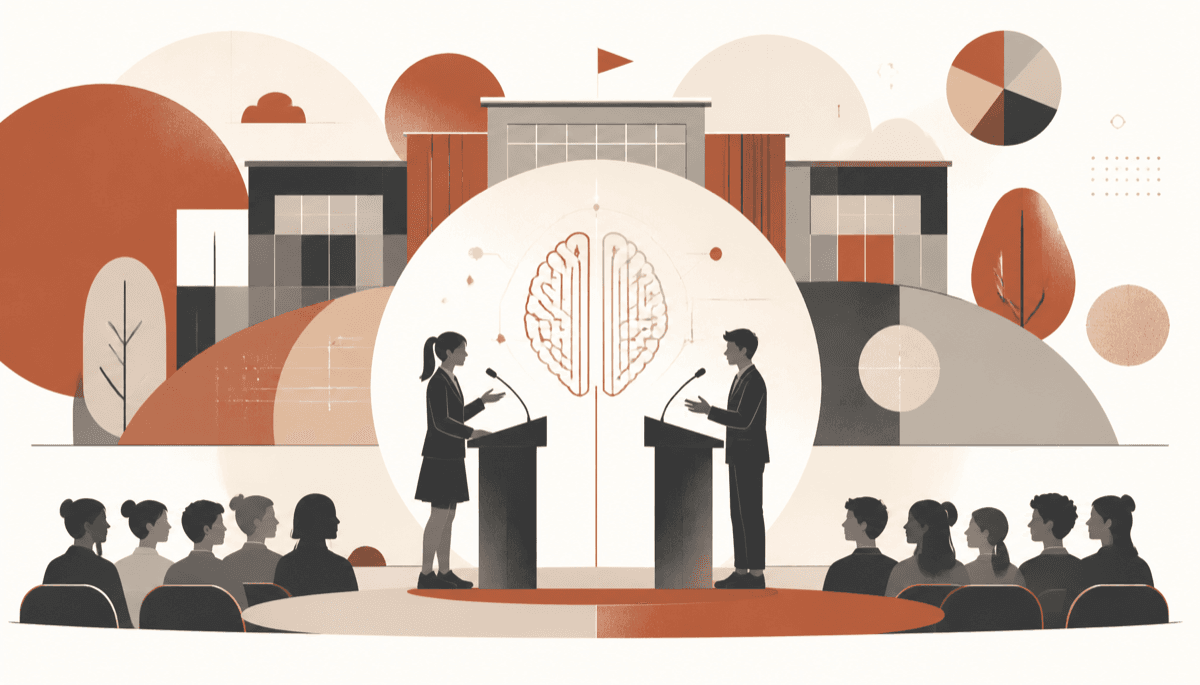
On August 1, the National Speech & Debate Association released the topics that will define its 2026–27 season. The headlines went mostly unnoticed outside the debate community, which is a shame, because the country’s most consequential AI literacy program just opened registration.
This year, the nation’s largest competitive debate circuit will send roughly 100,000 high school students into weekend tournaments arguing about hyperscale data centers, autonomous systems in deep space, whether technological progress has outrun our ethical capacity, and the future of national health insurance. Almost every major national topic runs through artificial intelligence in some way. The students do not get to pick their side. They research both, defend one, lose, switch, and do it again. They are graded by judges who have heard every cheap argument before.
That is not a curriculum. That is a laboratory.
The slate is the story
Start with the resolutions themselves.
Public Forum, September/October: “Resolved: The United States federal government should enact a moratorium on hyperscale data center construction.” The wording is narrow, but the subject is the physical backbone of the AI boom. Pew Research Center data, summarized by DebateCard, gives the debaters their ammunition: U.S. data centers consumed 183 terawatt-hours of electricity in 2024, more than 4% of total U.S. consumption, and are projected to hit 426 TWh by 2030. In 2023, data centers used roughly 26% of Virginia’s electricity, 15% of North Dakota’s, and 12% of Nebraska’s. The resolution forces students to weigh economic growth against grid stability, water use, local tax revenue, and whether a pause simply pushes the buildout overseas. The voters picked it decisively: 530 coaches and 2,401 students cast ballots, with the moratorium winning 80% of the coach vote and 68% of the student vote.
Lincoln-Douglas, September/October: “Resolved: Outer space colonization is a moral imperative.” At first glance, this is a philosophy topic. In practice, it is an AI topic in a spacesuit. Deep-space exploration is gated on autonomy; you cannot joystick a rover across a twenty-minute light delay. NASA’s Perseverance has already completed AI-planned drives on Mars, and companies like Starcloud are now talking about training models in orbit. Any serious case for colonization has to decide what machines can be trusted to decide alone, hundreds of millions of miles from anyone who can override them. The resolution won with 534 coaches and 2,285 students voting, taking 60% of the coach vote and 61% of the student vote.
Big Questions, the full year: “Resolved: Technological progress has surpassed humanity’s ability to use it ethically.” This is not AI-adjacent. It is the AI debate, entered as a resolution. It asks whether our tools are evolving faster than our judgment, and it won 74% of the coach vote and 57% of the student vote among 485 coaches and 1,830 students.
Policy Debate, the full year: “Resolved: The United States federal government should establish national health insurance in the United States.” This one is not explicitly about AI, but it will be impossible to argue well without it. AI is already shaping diagnosis, billing, prior authorization, and insurance risk scoring. The students who prepare the most credible health insurance cases will be the ones who understand how algorithmic decision-making changes the cost and quality predictions at the core of the debate.
Add these up, and something unusual is happening. For one academic year, a large cohort of American teenagers will be forced to understand AI not as consumers of headlines, but as producers of arguments. They will have to explain why a pause on data centers helps or hurts, why a machine can or cannot make a moral choice in deep space, and whether technological progress has a speed limit. They will do it under time pressure, against opponents who have read the same evidence, in front of judges who reward clarity and punish lazy thinking.
Why debate is the literacy we actually need
The new CSTA PK–12 Computer Science standards include AI literacy as a priority. Debate coach Stefan Bauschard noted something easy to miss in the document: the standards list “debate” as a practice for developing AI literacy. That is not a coincidence. The skills required to argue about AI are the skills required to think about AI clearly.
Reading an article about AI gives you a position. Arguing about AI gives you a relationship with the position. You discover whether your evidence is recent enough, whether your expert is actually an expert, whether your statistic proves what you think it proves, and whether your opponent’s counterargument is better than you want it to be. Debaters learn to separate a strong claim from a strong feeling, because strong feelings do not win rounds.
The research on debate’s educational effects has been consistent for years. Urban debate league participation has been associated with higher graduation rates, stronger test scores, and improved reading ability. Those gains are not because debate is a fancy vocabulary club. They are because debate is a feedback loop. You make an argument, someone attacks it, you rebuild it, and you do it again the next weekend. The loop is measured in days, not semesters, and it never stops.
What debating AI does that reading about AI cannot
Most people’s AI literacy is built on ingestion. They read summaries, watch explainers, and form opinions from the last article they read. That produces a brittle kind of knowledge: confident on the surface, hollow underneath.
Debate produces a different kind of knowledge. Here is what a student preparing the data center topic has to do in the next few weeks:
Map the argument architecture. They have to break the resolution into its load-bearing claims: how much energy do data centers actually use, how much will demand grow, what happens to electricity prices, would a moratorium reduce emissions or just shift construction, and what counts as “hyperscale” anyway. If one of those claims falls, the case falls with it.
Argue the other side. In competitive debate, you do not choose your position. You might spend the morning defending a pause on data centers and the afternoon defending the buildout. That is the single most effective cure for intellectual rigidity anyone has found. You cannot hate a position you are about to stand up and defend.
Evaluate evidence under pressure. Your opponent will read a card from an analyst at a think tank. You have ten seconds to decide whether the analyst has a relevant background, whether the study is recent enough to matter, and whether the quote is taken out of context. That is source literacy at speed.
Find the clash point. Two people can argue about data centers for an hour without ever intersecting. One talks about jobs, the other talks about climate, and they trade statistics past each other. A debater learns to find the single point where the two sides actually disagree: is the environmental and grid cost large enough to justify slowing the economic buildout? Everything else is noise.
Concede strategically. Non-debaters think conceding a point is losing. Debaters know that a smart concession narrows the fight to where you are strong and builds credibility. “You’re right that a moratorium would push some construction overseas; here is why it still reduces total emissions and protects the U.S. grid” is a stronger move than defending every inch of ground.
Separate the argument from the arguer. You can argue against someone’s case for forty-five minutes and then eat lunch together. In a world where disagreement routinely turns personal, this is a survival skill. It is also the skill that makes AI discussions productive, because AI discussions are often proxy wars for deeper disagreements about capitalism, regulation, and risk tolerance.
These are not debate skills. They are thinking skills, and the AI debate is the perfect stress test for them.
The students are rehearsing decisions the rest of us will make
The reason this season matters beyond the tournament circuit is that the questions on the ballot are the questions that will define the next decade.
Data centers are already reshaping local electricity markets. Towns are facing the choice between tax revenue and grid stability. Regulators are trying to decide whether to fast-track permits or slow them down. The students debating the moratorium are not playing a game. They are rehearsing the same tradeoffs that utility commissioners will make this year.
Autonomous systems in space are a preview of autonomous systems everywhere. The same logic that says an AI can plan a Mars drive because the round-trip delay is too long also applies to drones, submarines, and eventually weapons. If you are not comfortable with a machine deciding on Mars, you should probably not be comfortable with a machine deciding in a conflict zone. The LD resolution forces that connection into the open.
The Big Questions resolution is even more direct. “Technological progress has surpassed humanity’s ability to use it ethically” is the question behind every AI safety argument, every call for a pause, and every fight over open-weight models. It is not a technical question. It is a judgment question. Debate is the format that makes judgment questions answerable, because it forces you to name your values and defend them against someone who holds different ones.
Even the health insurance topic fits the pattern. The fight over national health insurance is partly a fight over who gets care and who pays. But it is increasingly a fight over who decides. If an algorithm denies your prior authorization, is that a medical decision or a corporate one? If an AI diagnostic is cheaper and more accurate than a specialist, do you have a right to see a human? The policy debaters who internalize those questions will understand the real debate better than most adults who read the headlines.
The uncomfortable exclusivity problem
There is a catch. Competitive debate is still a mostly extracurricular activity. It requires coaches, travel budgets, tournament fees, and free weekends. The students who would benefit most from this kind of training are often the least likely to get it.
That is the gap the rest of us should worry about. If the best AI literacy program in the country is a debate tournament, and debate tournaments are not evenly distributed, then AI literacy is not evenly distributed either. The skills these students are building—argument mapping, switch-side reasoning, evidence evaluation, framework thinking—are exactly the skills that will determine who can participate intelligently in AI policy and who gets persuaded by the first confident answer they hear.
Closing that gap is not just about funding more buses to tournaments, though that would help. It is about exporting the method. The format works because it is adversarial, fast, and iterative. You do not need a national circuit to get those benefits. You need a question worth arguing, an opponent who pushes back, and a willingness to lose and revise.
What the rest of us can learn from the season
The most important thing this debate season reveals is that AI literacy is not a content problem. It is a reasoning problem.
You can know every acronym in the AI stack and still be a bad citizen of the AI era. You can know nothing about transformers and still be a good one, if you know how to evaluate a claim, how to argue the other side, how to concede a point without losing your footing, and how to find the place where two positions actually disagree.
The high school debaters preparing these topics are not just learning about AI. They are learning how to hold a position without being owned by it. That is the skill that makes every other AI skill useful. Without it, the best research becomes a weapon for whatever you already believed. With it, research becomes a way to update what you believe.
The rest of us will make the actual decisions, eventually. But the students are rehearsing the arguments first. We should pay attention, because they are going to be sharper than we are by the time the questions reach the ballot box.
Related Posts

The Rhetoric Hack: How AI Judges Fall for Style Over Substance
New research shows AI peer reviewers can be reward-hacked by rhetorical style alone—no facts changed. What that means for the dream of using AI to evaluate arguments.

The Peer Pressure Machine: How AI Falls for Bad Arguments Under Pressure
New research shows GPT-4o can be talked into abandoning correct answers after just three turns of misleading persuasion. What AI's peer-pressure problem reveals about the skill of thinking for yourself.

The Explanation Trap: How AI Rationales Make Us Stop Thinking for Ourselves
New research shows that AI-generated rationales can degrade human judgment and cause cognitive atrophy. Why explanations that feel like reasoning may be the most dangerous AI output of all.
You just read the argument. Can you make one?
The AI takes the other side, every time. Three rounds, one scored verdict.
Argue today's Daily