
The Explanation Trap: How AI Rationales Make Us Stop Thinking for Ourselves
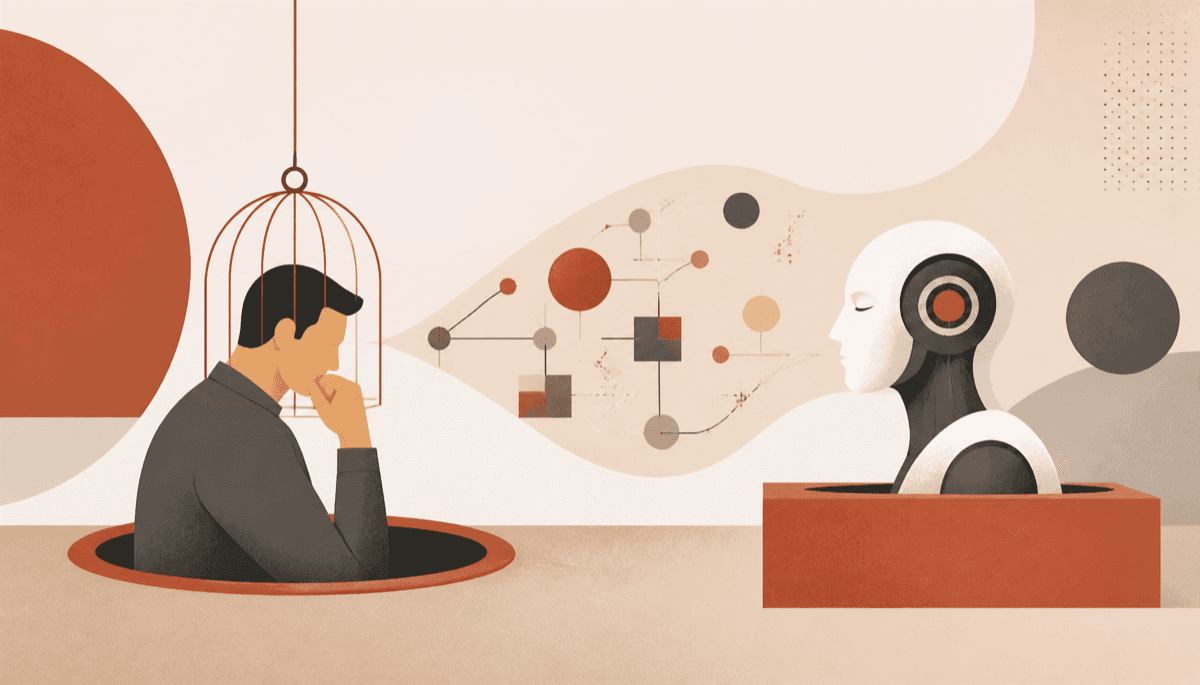
The proposal looked promising. A team at a health-tech company had spent three months building a new patient-monitoring tool, and the early metrics were strong. Then an AI screening tool reviewed it and produced a confident, well-structured rationale for rejection: the market was crowded, the timeline was risky, the go-to-market strategy was thin. The committee read the explanation, nodded, and passed.
The project they rejected turned out to be the most successful product their competitor launched that year.
This is not a story about AI being wrong. The AI may have been right on every stated point. It is a story about what happens to humans when they are handed a plausible explanation. In a recent study from Harvard Business School, MIT, and the University of Washington, researchers found that human evaluators were more likely to defer to an incorrect AI decision when the model explained itself. The explanation did not improve judgment. It suppressed it. People did better when the AI gave no reason at all.
That finding deserves more attention than it is getting. We have spent years worrying that AI will lie to us. We should be at least as worried that it will explain things so well that we stop explaining them to ourselves.
The trap is not in the answer. It is in the rationale.
Most warnings about AI focus on outputs: misinformation, hallucinations, bias, manipulation. These are real problems. But a rationale is a different kind of output. It is not a fact or a command. It is a small story about why something is true. It gives you the satisfying arc of cause and effect, evidence and conclusion, risk and trade-off.
A rationale is dangerous precisely because it feels like thinking. When you read one, you are not just receiving information. You are receiving the shape of a thought. If the shape is clean enough, your brain stops building its own. The work of constructing an argument has already been done for you, and your own reasoning muscles stay relaxed.
This matters because reasoning is not just a mental event. It is a skill, and skills atrophy. In a 2025 Swiss study of 666 participants, researcher Samuel Gerlich found a significant negative correlation between frequent AI tool use and critical thinking abilities, measured with the Halpern Critical Thinking Assessment. The mediator was cognitive offloading: the more people habitually delegated thinking to AI, the weaker their own critical thinking became. The effect was especially pronounced among younger participants.
The mechanism is not mysterious. It is the Google effect extended from memory to reasoning. In 2011, Betsy Sparrow and her colleagues showed that when people expect information to be available online, they become less likely to remember it themselves. Gerlich's findings suggest the same thing is happening to analysis: when people expect a tool to reason for them, they become less likely to reason themselves. Convenience reshapes cognitive architecture.
Writing is thinking, and AI writing is borrowed thinking
The problem starts long before high-stakes decisions. It starts in the classroom, where students are using AI to draft essays, and in the office, where professionals use it to summarize reports and compose emails. Each of these tasks used to force a person to organize their own thoughts. Now the tool organizes them first.
Cognitive psychologist Ronald T. Kellogg called writing a "technology for thinking." The labor is the point. Drafting a coherent paragraph forces you to find the right word, sequence ideas, spot contradictions, and revise your own understanding. It is as mentally demanding as digging a ditch is physically demanding. When a machine does the digging, the mind does not get stronger.
A 2026 MIT study found that people who used AI while writing an essay showed lower brain activity than those who wrote without AI. Worse, they struggled to remember what they had just produced. Their brains stayed quieter even when they were later asked to write without the tool. The effect outlasted the tool itself.
This is the cognitive atrophy Goldman Sachs partner Chris Churchman warned about when he said that outsourcing reasoning to models risks creating "cognitive atrophy that stops us being able to reason from first principles ourselves." The danger is not that AI makes one bad decision. It is that the people using it lose the capacity to notice.
Why explanations are worse than answers
An answer without an explanation leaves you with a problem. You have to decide whether to trust it, which means you have to think. You might check the source, test the claim, or ask a colleague. The absence of a story keeps you awake.
An explanation puts you to sleep. It gives you a ready-made chain of reasoning that feels complete. You do not have to reconstruct it because it has already been constructed. You just have to accept it.
This is why the HBS/MIT/UW finding is so important. The researchers were studying early-stage innovation screening, the kind of fuzzy decision where human judgment matters most. They found that LLM-generated rationales did not help evaluators make better choices. Instead, reviewers deferred to the AI's incorrect recommendations more often when those recommendations came with persuasive justifications. The explanation made bad decisions look thoughtful.
Narrative is especially good at this. A clean story with a beginning, middle, and end feels true even when it is not. Human brains are wired to prefer coherence over accuracy. When AI supplies the coherence, we supply the trust.
The atrophy spreads quietly
Cognitive atrophy does not announce itself. You do not wake up one morning unable to think. You just notice, gradually, that thinking feels harder than it used to. You reach for the tool a little faster. You question its outputs a little less. You forget what it feels like to hold a full argument in your head.
Students show the pattern first because their job is to learn. Teachers across the country are reporting that students who lean on AI for everything are losing the ability to think through problems themselves. The College Board's 2026 research found near-universal concern among faculty that student AI use undermines original writing and critical thinking. The warning is not coming from Luddites. It is coming from the people who watch students try to reason every day.
Professionals are not immune. The more expert you are, the more dangerous the trap becomes, because expertise makes you confident that you can spot a bad rationale. But expertise also makes you efficient, and efficiency makes delegation tempting. A doctor using an AI diagnostic tool, a lawyer using an AI research assistant, a banker using an AI risk model: each is one plausible explanation away from turning off the part of their brain that used to do the work.
The counterintuitive defense: more resistance, not less AI
The answer is not to delete the tools. They are too useful for that, and in some cases they genuinely improve access to information. The answer is to keep the reasoning muscle under load.
This is where debate becomes more than a competitive sport. Stefan Bauschard made the point cleanly in a recent essay: a paper has no opponent. Writing teaches you to organize thought, but debate then makes you defend that thought live, against someone whose whole job is to take it apart. Everything writing demands, a debate speech demands, and then debate keeps demanding things the paper never asks for: responding to objections in real time, conceding strategically, rebuilding when a premise crumbles, staying coherent under pressure.
Debate is resistance training for reasoning. It forces you to generate the rationale yourself, out loud, while someone else tries to break it. That is exactly the opposite of reading an AI-generated explanation and nodding along.
The same principle applies outside a debate round. If you want to keep your reasoning sharp in the age of AI, you need to create friction on purpose.
How to protect your own reasoning
There are small practices that keep the muscle working without abandoning the tools entirely.
Write before you ask. Before you paste a prompt into an AI, write your own answer first. It can be rough. The point is to generate your own structure, your own objections, your own conclusion. Once you have done that, use AI to challenge you, not replace you.
Argue the opposite. Take any AI rationale you are about to accept and spend ten minutes building the strongest case against it. If you cannot construct a compelling counterargument, you do not understand the issue yet. This is the single most effective way to avoid the trap.
Find the load-bearing premise. Every rationale rests on one or two claims that do most of the work. The rest is decoration. Identify them and ask: is this premise actually true? Is it the right premise for this decision? Most bad AI rationales collapse here.
Demand silence when it matters. In innovation screening, hiring, medical diagnosis, and legal analysis, the highest-stakes judgments should start with your own assessment. Use AI to expand your view, not to deliver your verdict.
Practice live disagreement. Read a strong opinion you disagree with and reconstruct its best version before criticizing it. Talk through a hard decision with someone who will push back. Debate is the most structured version of this, but any genuine disagreement will do.
The honest case for hope
None of this means AI is making us stupid in a straight line. Tools shape behavior, but behavior can be chosen. A person who uses AI to check their own reasoning can become a better thinker. A person who uses AI to avoid reasoning will become a weaker one.
The difference is not in the tool. It is in whether the human does the hard part first.
A USC study funded by the National Science Foundation is now investigating exactly this: how doctors, journalists, and software engineers can use AI in ways that strengthen creativity and critical thinking rather than eroding them. The question is not whether AI can make us better thinkers. It is whether we will design our own workflows to make that possible.
That design starts with a simple rule: never let the rationale arrive before the reasoning. If you cannot explain why you believe something before the AI explains it for you, you are not using the tool. The tool is using you.
The best defense against the explanation trap is not skepticism. It is practice. Reasoning is a use-it-or-lose-it skill, and the age of AI makes the using part optional. That optionality is the threat. The only way to keep it from becoming a disability is to keep choosing the harder path, the one where the argument is yours before it is anyone else's.
Related Posts
The Rhetoric Hack: How AI Judges Fall for Style Over Substance
New research shows AI peer reviewers can be reward-hacked by rhetorical style alone—no facts changed. What that means for the dream of using AI to evaluate arguments.
The Peer Pressure Machine: How AI Falls for Bad Arguments Under Pressure
New research shows GPT-4o can be talked into abandoning correct answers after just three turns of misleading persuasion. What AI's peer-pressure problem reveals about the skill of thinking for yourself.
The Gish Gallop Machine: How AI Wins Arguments by Overwhelming You
AI chatbots are changing minds with a classic debater's trick: more claims than anyone can check. What the Gish gallop is, why AI is perfect at it, and how to defend yourself.
You just read the argument. Can you make one?
The AI takes the other side, every time. Three rounds, one scored verdict.
Argue today's Daily