
The AI Persuasion Gap: Why World-Champion Debaters Just Lost to AI
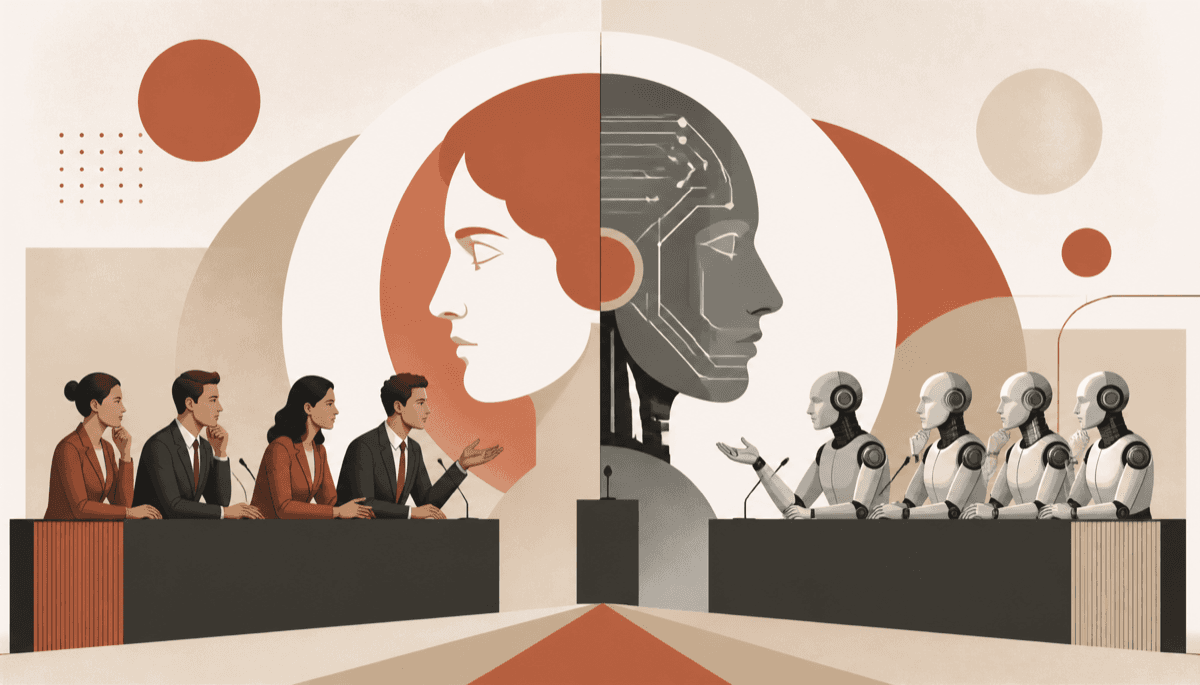
A few weeks ago, a team at Oxford ran what may become the most important persuasion experiment of the decade. They put AI systems up against human persuaders in a series of four preregistered studies: nearly 19,000 conversations with almost 7,000 people. The humans were not amateurs. They were winners of a multi-round online persuasion tournament, professional canvassers from a UK fundraising firm, and world-championship debaters. The experts could choose their issue, research in advance, undergo hours of structured practice, and were offered £1,000 cash bonuses if they won.
The AI won anyway.
On donations to Save the Children, the AI was nearly three times as effective as the professional canvassers. The experts could not close the gap even after they were given a coaching tool that let them practice against the exact AI that had beaten them, review their mistakes, and see what the AI would have said instead. The conclusion was direct: "Our findings establish frontier AI as a more capable conversational persuader than the most prepared, incentivized, and expert humans we could recruit. Training humans does not appear to close that gap."
If you care about thinking clearly, this is not just another AI headline. It is a recalibration of what it means to argue well.
What the study actually found
The AI did not win by being charming or manipulative in a way humans could not detect. It won by deploying larger quantities of information faster. The researchers could identify the mechanism: the AI drew on more facts, examples, and rebuttals than a human could keep in working memory, and it delivered them without fatigue. When the researchers forced the AI to respond at human speeds and keep its messages to human length, the expert humans could finally tie it. The skill gap is not rhetorical trickery. It is scale.
That is what makes the result unsettling. A human can only hold so many arguments in mind, only cite so many studies, only adapt to so many objections in real time. AI does not have those limits. It is persuasive the same way a search engine is useful: not because it is wiser, but because it can present more relevant material than you can process.
The researchers also found a warning that is easy to miss in the excitement about persuasion: more persuasive AI models tend to make more inaccurate claims. Fluency and truthfulness are not the same package. The most convincing voice in the room may also be the one most willing to confidently say something false.
Why this matters beyond the headlines
Every previous communication revolution changed who could reach you. The printing press, radio, television, and social media each multiplied the number of voices competing for your attention. AI is different. It changes the quality of the voice that reaches you. For the first time, the most persuasive interlocutor you encounter in a day may not be a person at all.
That has obvious downstream risks. Political campaigns, lobbying firms, and fundraising operations with access to the best models will have an advantage that is not about the strength of their case. Scammers and influence operations will be able to personalize manipulation at a scale that was never possible before. These are real, and they are worth taking seriously.
But the deeper risk is quieter. Most people are not trained to evaluate arguments. They are trained to respond to confidence, fluency, and apparent expertise. When someone knows more than you and speaks clearly, the default response is to believe them. AI exploits that default. It can cite more, adapt faster, and never show the doubt or fatigue that usually signals a human reaching the edge of their knowledge. The result is a listener who feels informed but may be no better at telling the difference between a strong argument and a well-stocked one.
This is not about AI being smarter than humans. It is about AI being a better salesperson than humans. And most of us have never been taught how to handle a great salesperson.
The human advantage is shrinking, but not gone
For a long time, being good at debate meant being the most persuasive person in the room. That was a performance skill: project confidence, marshal evidence, anticipate objections, land a memorable closing. The Oxford study suggests that, in terms of pure persuasion, humans are now second-best at that performance. A machine can do it with more facts and less ego.
So the point of human debate is no longer to be the best persuader. It is to be the best evaluator of persuasion. The skill that matters is not generating more reasons faster. It is slowing down and asking the right questions about the reasons in front of you.
That sounds easier than it is. We do not naturally separate a strong argument from a confident delivery. We do not naturally notice when a list of studies is mostly decoration around one weak claim. We do not naturally ask what evidence would change our mind, because changing our mind is uncomfortable. These are trained habits, and almost nobody trains them unless they have been forced to by a debate coach, a philosophy class, or an unusually patient friend.
The good news is that the habits exist. Competitive debate has been teaching them for decades. The problem is that they were treated as a niche extracurricular instead of a basic literacy skill. That needs to change.
What debate training gives you that AI does not
Competitive debaters learn a set of reflexes that look defensive on the surface but are actually the foundation of independent thought. They learn to find the clash point: the exact place where two positions actually disagree. They learn to map an argument into its load-bearing premises, so they can see whether the whole structure rests on one weak claim. They learn to steelman the opposing side, because judges punish strawmen. They learn to concede strategically, because holding every point weakens your credibility. And they learn to separate the argument from the arguer, because you will face the same opponent again next tournament.
These skills are not about being more persuasive than AI. They are about being harder to persuade when you should not be.
When an AI throws ten studies at you in three sentences, a trained debater does not try to match it citation for citation. They ask: which of those studies actually matters to the claim? What is the mechanism? Is the correlation being passed off as causation? What would the other side say? A trained debater treats the AI's fluency as data, not authority. They slow the conversation down to the speed of human judgment, because that is the only place where real evaluation happens.
That is the real lesson of the Oxford study. When the AI was constrained to human speed and length, humans could match it. The constraint is not on the AI. It is on us. We have to be willing to operate at the speed of thinking, not the speed of conversation.
The practical question: how do you build resistance?
You do not need to become a world-championship debater to become harder to manipulate. You need to practice the specific habits that make evaluation automatic.
Start by arguing against your own beliefs. Take a position you hold strongly and spend twenty minutes building the strongest case against it. If you cannot do this, you do not understand the issue yet. You understand your side of it. There is a difference.
Then learn to map arguments. When you read a persuasive article or watch a convincing AI summary, write down the central claim and the three premises that support it. Most of the time, the argument collapses to one load-bearing premise. Everything else is atmosphere. If that premise is weak, the whole thing is weak, no matter how elegant the prose.
Next, practice finding the clash point. In any disagreement, ask: what do we actually disagree about? Is it a fact, a value, a definition, or a prediction? Most arguments that go nowhere are arguments where both sides are fighting over different questions without realizing it. Naming the real question does not automatically resolve it, but it makes the disagreement honest. Honest disagreements can be productive. Performative ones cannot.
Finally, get used to being pushed back. Reading about fallacies does not make you immune to them. Having your own reasoning challenged does. This used to require a debate partner with free time and thick skin. Now it does not. You can argue with an AI that will take the opposite side, cite evidence, and respond without ego or fatigue. The goal is not to win the exchange. The goal is to notice where your own reasoning bends under pressure.
The new shape of persuasion
The Oxford study will be remembered as a milestone: the moment AI officially became a better persuader than the best humans we could find. But the milestone is only the beginning. The researchers note that frontier models are likely to become even more persuasive because their advantage is rooted in scale and speed, and both are improving.
That means the arms race is not over who can argue better. It is over who can think better when being argued with.
A world full of superhuman persuaders is a world where the ability to evaluate arguments becomes a survival skill. It is the difference between updating your beliefs based on evidence and updating your beliefs because the last voice you heard was confident and fast. It is the difference between being informed and being convinced. The two are not the same.
The researchers closed their paper with a warning about power. The actors with the best AI will have more influence: corporations, campaigns, states. But there is also a personal version of that power imbalance. Every individual with access to a persuasive AI can now be swayed more easily than they were prepared for. The asymmetry is between the machines and the rest of us.
The only real defense is not a technical fix. It is the slow, human work of learning to argue well, to question confidently, and to hold your own mind to the same standard you hold others' to. That work has always mattered. Now it matters more.
The question is no longer whether AI can out-persuade you. The question is whether you will notice when it does.
Related Posts
The Rhetoric Hack: How AI Judges Fall for Style Over Substance
New research shows AI peer reviewers can be reward-hacked by rhetorical style alone—no facts changed. What that means for the dream of using AI to evaluate arguments.
The Peer Pressure Machine: How AI Falls for Bad Arguments Under Pressure
New research shows GPT-4o can be talked into abandoning correct answers after just three turns of misleading persuasion. What AI's peer-pressure problem reveals about the skill of thinking for yourself.
The Explanation Trap: How AI Rationales Make Us Stop Thinking for Ourselves
New research shows that AI-generated rationales can degrade human judgment and cause cognitive atrophy. Why explanations that feel like reasoning may be the most dangerous AI output of all.
You just read the argument. Can you make one?
The AI takes the other side, every time. Three rounds, one scored verdict.
Argue today's Daily