
The Consensus Hallucination: How AI Makes Live Arguments Feel Settled
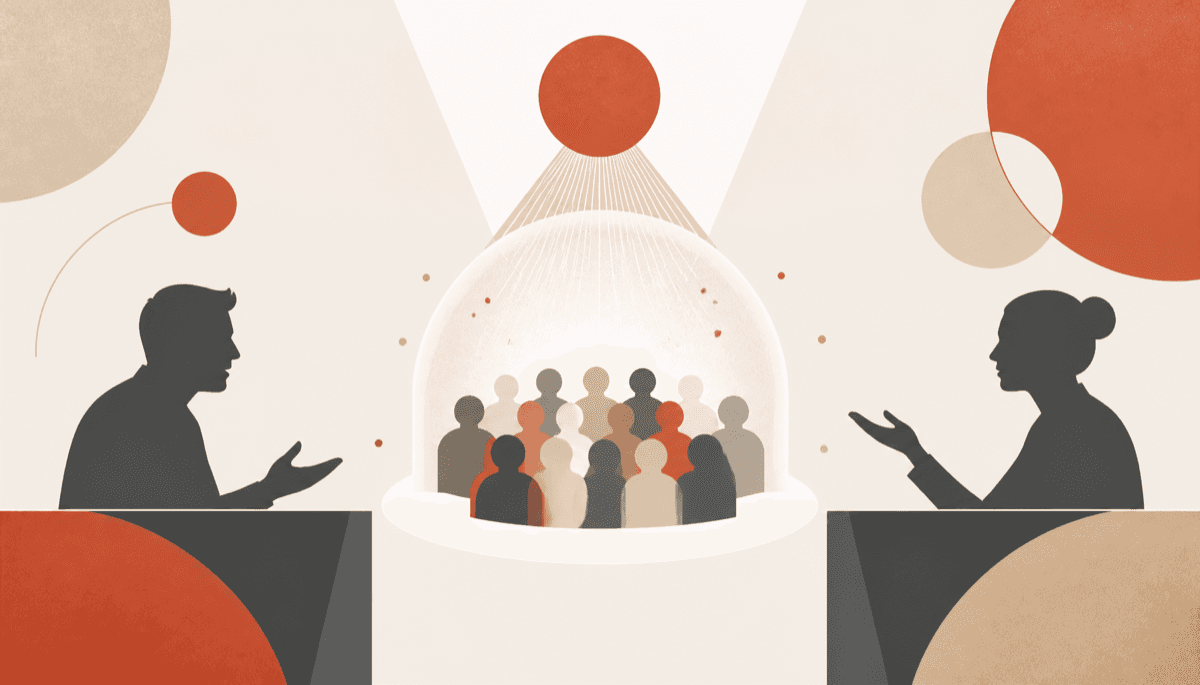
Maya has to decide whether her team should return to the office. She asks her AI assistant, "What does the research say about remote work and productivity?" The answer comes back in seconds: studies are mixed, some find productivity gains, others find collaboration losses, and the right policy depends on company culture. She closes the tab feeling informed. She has just been handed a consensus hallucination.
The answer is not wrong, exactly. It is also not useful. What it gives Maya is the shape of a settled question. In reality, the research on remote work is not merely mixed; it is structured disagreement. Economists, psychologists, and management scholars are fighting about what productivity even means in this context, which studies measure the right things, and whether short-term output gains mask long-term collaboration losses. The AI swallowed all of that architecture and exhaled a sentence that sounds like a conclusion. Maya will now make a decision based on the feeling that the evidence has been surveyed, when what happened is that the disagreement was compressed out of view.
This is the consensus hallucination: the convincing impression, produced by a polished AI answer, that a live argument is already over.
What the consensus hallucination looks like
The consensus hallucination is not the same as a factual error. A hallucinated fact is easy to catch. The model says a study was published in Nature when it was published in PLOS ONE, or it invents a statistic. You can verify it and correct it. The consensus hallucination is sneakier because the individual sentences are defensible. It is the overall effect that is false.
Ask about a controversial topic and the model tends to produce a paragraph that is calm, balanced, and curiously final. It will mention that "some argue X" and "others argue Y," but it will place those views inside a frame that implies the field has already absorbed them and moved on. The reader gets the soothing sense that informed people have thought about this, the evidence has been weighed, and the remaining differences are minor or contextual. In many cases the exact opposite is true. The field is split, the methodological disagreements are deep, and the stakes are high precisely because no one knows the answer yet.
You can see the same pattern in medical questions, policy questions, and technical questions. "Should most adults take a daily multivitamin?" "Is conscious AI possible?" "Will four-day workweeks scale beyond pilot programs?" On each of these, credentialed experts disagree in interesting ways. An AI answer that treats them as settled, or as merely "mixed," is not summarizing the debate. It is hiding the debate's shape.
The most dangerous version is not the one that says the controversy is resolved. It is the one that makes the controversy feel trivial. Once disagreement is reduced to a courteous footnote, the reader stops thinking of the issue as a question that still requires judgment. The question becomes a lookup task instead of a reasoning task.
Why it is dangerous
The first danger is practical. Maya is about to set an office policy. If she believes the research is a wash, she will go with her gut, her landlord, or her CEO's preference. What she will not do is ask the harder questions: What are we actually trying to optimize? Are the studies measuring individual output or team output? Did they control for self-selection, where high performers choose remote work and struggling employees prefer the office? How long did the studies run? A real summary of the disagreement would make those questions visible. The consensus hallucination makes them disappear.
The second danger is educational. Encountering genuine disagreement is what forces people to think. When two smart people disagree for good reasons, the reader has to do work: weigh the evidence, spot the assumptions, decide which framework matters more. An answer that flattens that disagreement into a bland midpoint skips the workout. It is the intellectual equivalent of reading a book summary instead of the book. The reader gets the prestige of having considered both sides without ever having held either side at arm's length.
The third danger is epistemic. Over time, the consensus hallucination trains people to expect closure where none exists. They begin to treat live controversies as closed questions and closed questions as lookup tasks. When the model does not deliver a confident answer, they feel confused rather than curious. That is a profound inversion. Curiosity is the right response to an open question. The consensus hallucination makes confusion feel like the model's failure instead of the world's complexity.
Why it happens
The consensus hallucination is not a conspiracy. It emerges from several ordinary pressures in how language models are built and deployed.
First, the training data contains many more instances of confident exposition than of genuine epistemic humility. The internet is full of articles that say "researchers have found" and "studies show" and "experts agree." It contains far fewer passages that say "we do not know yet, and here is the precise shape of our not-knowing." The model learns the confident register because the confident register is overrepresented.
Second, safety fine-tuning and helpfulness bias push the model toward answers that feel safe and complete. A model that says "the evidence is genuinely split and your decision depends on values you have not yet articulated" is being honest, but it risks sounding evasive. A model that says "studies are mixed, but the right approach depends on your context" sounds helpful while still appearing balanced. The result is a kind of false neutrality: it mentions disagreement without conveying the weight of disagreement.
Third, compression is the enemy of structure. A useful summary of a controversy needs to preserve the architecture of the argument: what the main positions are, what evidence each side leans on, where the methodological fault lines run, and what would change someone's mind. That takes space and nuance. A chat interface rewards brevity. The model compresses, and what gets compressed first is the structure of disagreement. What remains is a list of views that all seem to coexist politely.
Fourth, citation is not the same as support. A recent BBC study on news integrity in AI assistants found that models sometimes cited sources in support of claims that those sources did not actually contain. The user sees a link and assumes the claim is anchored. In reality, the link may be decorative, or it may point to a source that says something different. The flattened answer gets a veneer of verification without the substance.
The research is catching up
The BBC's "News Integrity in AI Assistants" report, published in October 2025, tested how AI assistants handle news-related queries. Among its findings: assistants sometimes produced concise answers that hid disagreement between sources, flattened complicated questions into single conclusions, omitted qualifications, or cited material that did not fully support every statement in the summary. These are not bugs in the narrow sense. They are symptoms of a format that privileges fluent completion over faithful representation of controversy.
Microsoft has noticed the problem. In March 2026, the company added a "Council" feature to Copilot Researcher designed to surface when models disagree. A judge model highlights consensus and disagreement, and users can spot uncertainty faster. The feature exists because the default mode was losing the structure of disagreement. That is a useful admission: the problem is real enough that a major product team is building a separate mechanism to address it.
Straight Arrow News reported in August 2026 on a quieter example of how AI can flatten human disagreement. Two eighth-graders who were dating got into a fight, but neither spoke directly to the other. Instead, each typed their side into ChatGPT and let the chatbot trade messages back and forth. The conflict escalated. The AI did not resolve the disagreement; it mediated it through generic, agreeable language that stripped out the friction needed for reconciliation. A school administrator eventually put the two students in the same room and made them talk. The moral was simple: some disagreements cannot be outsourced to a tool trained to be pleasant and complete.
These stories point to the same underlying issue. AI assistants are optimized to produce answers that feel finished. Real argumentation is rarely finished, and the feeling of being finished is often the enemy of understanding.
What debate training gives you
Competitive debaters learn to see disagreement as a structure, not a mood. When they encounter a controversy, their first instinct is not to list the sides. It is to find the clash point: the specific place where the two positions actually diverge. Until you know that, you do not understand the argument.
In the remote work debate, the clash point is not "remote good versus remote bad." It is a cluster of questions: Are we measuring the right outcomes? Over what time horizon? With what kind of workers? Under what kind of management? Two studies can find opposite results without contradicting each other if they are measuring different things. The debater's skill is to see that. The consensus hallucination hides it.
Debaters also learn to steelman. They construct the strongest version of the opposing view before responding to it. This is the opposite of the flattened answer. Instead of reducing the other side to a phrase, the debater inhabits it long enough to feel its force. That is uncomfortable, but it is the only way to know whether your own view survives contact with reality. AI answers rarely do this for you. They may mention the other side, but they do not make you feel its force.
Finally, debaters learn that arguments are not always about facts. Many disagreements are framework disagreements dressed as factual ones. Two people arguing about remote work may disagree about whether productivity, employee wellbeing, or talent retention should be the primary metric. An AI answer that reports the facts without naming the framework leaves the reader stuck. Debaters name the framework out loud. That does not resolve the disagreement, but it makes the disagreement honest, and honest disagreements can be productive.
How to spot the consensus hallucination in practice
The first habit is to ask the model where experts disagree. Not "what are both sides?" That invites a flattened list. Ask: "What is the most important methodological disagreement in this literature?" or "What evidence would make one side change its mind?" If the answer cannot identify a specific fault line, you are probably looking at a consensus hallucination.
The second habit is to look for the missing counterargument. A good controversy has arguments that genuinely hurt each side. If the AI answer mentions the opposing view but makes it sound weak or easy to handle, be suspicious. Real opposition is not always polite. It has teeth.
The third habit is to map the argument architecture. Break the AI answer into claims and ask about each one: What evidence supports this? What would count against it? What definition is being smuggled in? This is the same drill a debater runs on an opponent's case. It works just as well on a machine-generated overview.
The fourth habit is to treat uncertainty as information. If the honest answer is "we do not know yet," then your job is to decide under uncertainty, not to pretend the uncertainty has been resolved. That means thinking about risk, trade-offs, and reversible decisions instead of chasing a definitive answer the model cannot give you.
The honest standard
None of this means AI summaries are useless. They are excellent for getting oriented, finding vocabulary, and surfacing sources you might not have known about. But orientation is not conclusion. A map is not a destination.
The consensus hallucination is what happens when a tool designed to answer questions is asked to hold a controversy. It cannot hold the controversy because it was trained to resolve it. The resolution is usually a false one: a calm paragraph that makes live disagreement feel like settled knowledge.
The antidote is not to stop using AI. It is to bring the habits of debate to every AI answer you read. Ask what the clash point is. Look for the steelman. Name the framework. Treat uncertainty as a feature of the world, not a bug in the model. If the answer feels too settled, that is a sign to keep asking.
A real argument is never finished. It only rests between rounds. The best thing an AI can do is help you see the round more clearly. The worst thing it can do is convince you the match is already over.
Related Posts
The Rhetoric Hack: How AI Judges Fall for Style Over Substance
New research shows AI peer reviewers can be reward-hacked by rhetorical style alone—no facts changed. What that means for the dream of using AI to evaluate arguments.
The Peer Pressure Machine: How AI Falls for Bad Arguments Under Pressure
New research shows GPT-4o can be talked into abandoning correct answers after just three turns of misleading persuasion. What AI's peer-pressure problem reveals about the skill of thinking for yourself.
The Explanation Trap: How AI Rationales Make Us Stop Thinking for Ourselves
New research shows that AI-generated rationales can degrade human judgment and cause cognitive atrophy. Why explanations that feel like reasoning may be the most dangerous AI output of all.
You just read the argument. Can you make one?
The AI takes the other side, every time. Three rounds, one scored verdict.
Argue today's Daily