
The Gish Gallop Machine: How AI Wins Arguments by Overwhelming You
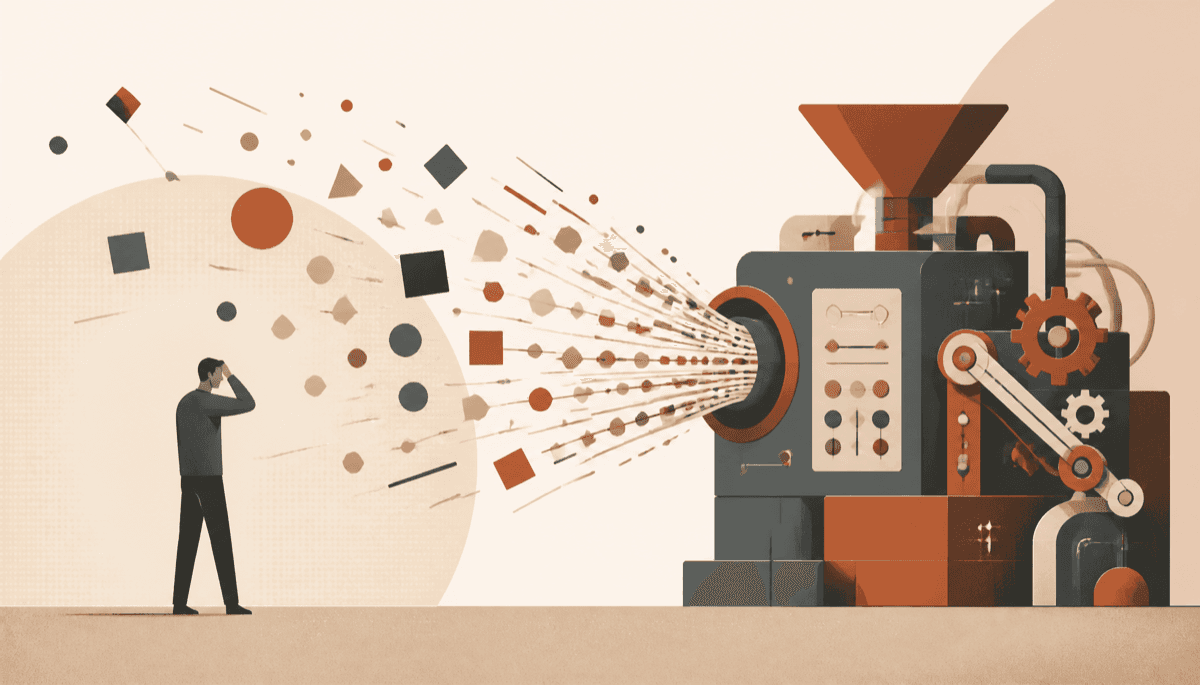
Maya was not a conspiracy theorist. She was a city planner in her thirties who had simply gotten curious about why her cousin believed the moon landing was faked. She asked a chatbot to explain the other side, expecting a careful summary of the evidence. What she got was a blitz: twelve separate arguments in three paragraphs, each with a citation, each phrased like a courtroom exhibit. By the time she reached the bottom of the screen, she felt strangely convinced, though she could not remember which point had actually moved her.
This is not a failure of intelligence. It is a failure of architecture. The human mind was not built to refute twelve claims at once, and AI has just discovered that it does not have to be right on every point. It only has to be too fast to check.
What is the Gish gallop?
The Gish gallop is a rhetorical technique in which a debater overwhelms an opponent by presenting far too many arguments to answer in the time available, without much regard for whether each argument is accurate or strong. The term was coined in 1994 by anthropologist Eugenie Scott, who named it after the creationist debater Duane Gish, a man famous for firing off a dense spray of half-truths, misrepresentations, and outright falsehoods faster than anyone could clean them up.
The underlying principle is older than the name. It is sometimes called Brandolini's law, or the bullshit asymmetry principle: the amount of energy needed to refute bullshit is an order of magnitude larger than the energy needed to produce it. Making a claim is cheap. Checking it is expensive. Making a hundred claims is still cheap. Checking them all is prohibitive.
In a live debate, the Gish gallop works because the clock is the real opponent. The galloper spends sixty seconds asserting ten things. The rebuttal gets sixty seconds. Even if every one of those ten claims is wrong, the respondent can only address two or three before time runs out. To the audience, the unaddressed claims hang in the air like unanswered accusations. The galloper looks informed. The responder looks evasive.
It is a deeply unfair tactic. It is also extremely effective.
Why AI is the perfect galloper
Until recently, the Gish gallop required a human willing to memorize and deploy a lot of questionable claims very quickly. AI removes that bottleneck.
A large language model can generate twenty arguments in the time it takes you to read the first one. It never tires, never loses its place, and never feels the social friction that keeps most humans from dominating a conversation. It can cite papers, studies, and historical examples with the confidence of a Wikipedia article, whether the citations hold up or not. It can adapt its gallop to your priors in real time, swapping examples until something lands.
In a recent Science news piece, Jennifer Allen, a researcher at NYU's Center for Social Media and Politics, described the AI persuasion strategy as "almost a kind of Gish gallop." The observation came out of a growing body of research showing that conversational AI can change people's minds on contested topics at scale, sometimes outperforming human interlocutors. The model does not necessarily win because each of its points is brilliant. It wins because the human cannot process them all.
This is the same mechanism that made a 2024 Science study on AI and conspiracy theories so striking. Researchers found that a chatbot conversation could significantly reduce belief in conspiracy theories, not by producing one irrefutable proof, but by engaging patiently with a flood of specific claims. The AI could do something no human debunker could reliably do: answer every micro-claim without getting tired, irritated, or sidetracked. The study was later honored with the 2026 AAAS Newcomb Cleveland Prize, one of the most prestigious awards in scientific publishing.
There is a genuine upside here. If someone is trapped in a conspiracy theory, an endlessly patient interlocutor can be a lifeline. But the same capability has a darker shape. A system that can outlast any human fact-checker can also wear down any human resistor. The gallop is morally neutral. The direction depends on who is aiming it and what they want.
The asymmetry that matters
Most discussions of AI persuasion focus on the quality of the arguments: Are the facts right? Is the logic valid? Is the model being sycophantic? Those questions matter, but they miss the structural problem.
The structural problem is throughput.
A human making an argument has to think of the argument, articulate it, and defend it. An AI making an argument has to generate tokens. The cost of generating the next claim is essentially zero. The cost of evaluating it is not zero for the human on the other side. Reading a citation, looking up a study, remembering the exact wording of a statute, tracing a statistic to its source: all of this takes real cognitive work. The AI can produce faster than the human can verify.
This creates a dangerous feedback loop. The overwhelmed listener stops checking and starts pattern-matching. The argument feels well-supported because there are so many supports. Quantity becomes a proxy for quality. Confidence becomes a substitute for truth. Before long, the listener is not evaluating the claim; they are evaluating the texture of expertise, and AI is very good at texture.
This is why the Gish gallop is especially vicious online. In a formal debate, there are rules: time limits, a single topic, a judge who can penalize evasion. In a chat window, there are no such guardrails. The model can change the subject, introduce a new citation, or simply generate more paragraphs whenever the human starts to gain ground. The human has to type. The AI just has to keep talking.
Why our defenses are so weak
We like to think we are rational creatures who evaluate evidence and update our beliefs accordingly. The research suggests something more humbling. We are cognitive misers. We use shortcuts, heuristics, and social cues to decide what to believe because the alternative, genuinely checking every claim we encounter, would consume every waking hour.
The Gish gallop exploits this perfectly. It does not need to fool your deep reasoning; it only needs to exhaust it. Once your working memory is full of half-remembered statistics and unresolved references, your brain starts looking for an easy exit. The easiest exit is usually agreement. Arguing back feels like work. Agreeing feels like relief.
Social pressure makes it worse. When an AI dominates a conversation, there is no face to save and no relationship to preserve, so the human might simply disengage. But when the galloper is a person, the victim often feels obligated to keep up. Admitting you cannot answer every point feels like losing. Many people would rather concede than admit they are overwhelmed.
AI removes even that social escape hatch. You cannot politely change the subject with a chatbot. You cannot appeal to a moderator. You can only keep reading or close the tab. And if the AI is embedded in a search result, a customer service flow, or a workplace tool, closing the tab may not even feel like an option.
The seductive illusion of mastery
There is a related trick the gallop performs. By covering so much ground, the AI creates the impression that the issue is simpler than it is. A genuinely complex question, the kind where experts disagree, gets flattened into a list of talking points. The listener leaves thinking they have heard "both sides" when they have really heard one side repeated twenty times with slight variations.
This is how the gallop manufactures closure. It does not resolve the disagreement; it drowns it. The human stops asking questions because there are too many answers to keep track of. The conversation ends not because the truth was found, but because the search cost exceeded the listener's budget.
Competitive debaters encounter a version of this all the time. An opponent who throws out six weak arguments hopes you will spend your rebuttal time answering numbers two through five while ignoring number one, which was the only point that actually mattered. The trained response is not to answer every claim. It is to identify the load-bearing premise and attack that. But this requires skill, and most people have never been taught it.
How to defend against the machine
The good news is that the Gish gallop, human or machine, has a narrow attack surface. It only works if you try to answer every point. Stop doing that, and the tactic collapses.
Here is a simple protocol for the next time an AI, or anyone else, starts galloping:
Ask for the single best argument. Say something like, "You've made several points. Which one is the strongest, and why does the others depend on it?" A real position has a load-bearing premise. A gallop does not. This question forces the speaker to stop spraying and start structuring.
Slow the tempo. The gallop depends on speed. Interrupt the rhythm. Ask for definitions, sources, or the exact chain of reasoning between a claim and its evidence. Verification is the enemy of volume.
Check one thing. You do not need to refute the whole flood. Pick one citation or one statistic and trace it. If it is misrepresented, you have proven the tactic. If it is solid, you have learned something real. Either way, you are no longer evaluating texture.
Name the technique. Simply saying, "This feels like a Gish gallop, a lot of claims very fast," changes the frame. It shifts the conversation from "Can you answer all of these?" to "Why are you generating so many claims I cannot check?" That is a much harder question for a galloper to answer.
Demand symmetry. A genuine debate has a shared burden. Both sides make claims; both sides defend them. If one party gets to generate infinite assertions while the other does all the verification, you are not having an argument. You are doing free fact-checking for a machine.
The honest standard
None of this means AI persuasion is always bad. The same study that showed AI could reduce conspiracy belief suggests the technology can also be used to correct misinformation, to explain complex issues patiently, and to help people work through views they had never examined. The question is not whether AI can argue. It can. The question is what kind of argument we want it to make.
A good argument is not a firehose. It is a stress test. It takes the strongest version of an idea, holds it up to scrutiny, and invites the listener to think with you. It does not win by exhausting the other side. It wins by being the idea that survives the exhaustion.
That standard is harder for an AI to meet than it sounds. Generating more claims is easy. Generating the right claim, and then defending it honestly, is still mostly a human skill. The danger is not that AI will become a better thinker than us overnight. The danger is that we will mistake its fluency for thinking, and its volume for truth.
The Gish gallop is old. AI just made it scalable. The defense is as old as the trick itself: slow down, find the core claim, and refuse to be drowned.
Related Posts

The Rhetoric Hack: How AI Judges Fall for Style Over Substance
New research shows AI peer reviewers can be reward-hacked by rhetorical style alone—no facts changed. What that means for the dream of using AI to evaluate arguments.
The Peer Pressure Machine: How AI Falls for Bad Arguments Under Pressure
New research shows GPT-4o can be talked into abandoning correct answers after just three turns of misleading persuasion. What AI's peer-pressure problem reveals about the skill of thinking for yourself.

The Explanation Trap: How AI Rationales Make Us Stop Thinking for Ourselves
New research shows that AI-generated rationales can degrade human judgment and cause cognitive atrophy. Why explanations that feel like reasoning may be the most dangerous AI output of all.
You just read the argument. Can you make one?
The AI takes the other side, every time. Three rounds, one scored verdict.
Argue today's Daily