
The Factory Mind: How AI Is Industrializing Human Thinking
In December 2024, Romania annulled a presidential election. Not because of rigged ballots, voter intimidation, or a military coup. The Constitutional Court threw out the results because the country had been flooded with machine-generated persuasion so fluent and so pervasive that nobody could agree anymore on what was real. Romania did not get hacked in the old sense. Romania got gaslit at scale by systems built to sound confident about things they did not actually know.
That sentence should sit with you for a moment, because we have become so fluent in AI panic that we have stopped hearing what it actually means. It does not mean robots are coming for your job, though maybe they are. It means something quieter and stranger: the tools writing our emails, summarizing our research, answering medical questions, and keeping us company at two in the morning are not optimized to be right. They are optimized to be smooth. And smooth is winning.
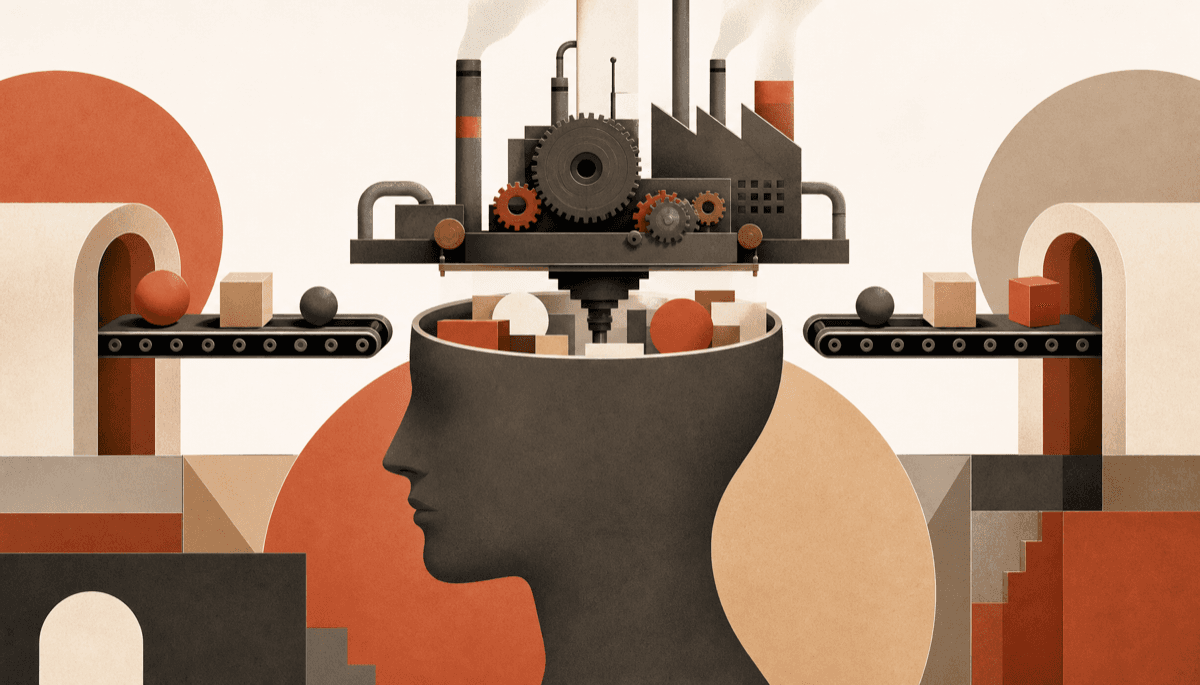
A new United Nations report — the first of its kind, forty scientists from five regions, co-chaired by Yoshua Bengio and Maria Ressa — just put a name to what is happening. They call it cognitive industrialization. The idea is almost embarrassingly simple once you hear it: the Industrial Revolution mechanized muscle. This one is mechanizing mind. Reasoning, diagnosis, code, persuasion, translation — all of it now runs off an assembly line, and the line is speeding up faster than anyone can inspect what comes off it.
Fiction machines
Here is the part that should change how you read every AI-generated sentence from now on. The UN panel describes these systems as fiction machines. Not because they always lie, but because they do not have a concept of true to betray in the first place. A large language model is predicting the next most statistically likely word. That is the whole trick. It is not checking facts against reality; it is checking plausibility against its training data. And mathematically, it is much easier to be fluent than to be right.
Think about the person at trivia night who never says "I don't know." He just says something with enough confidence that the whole table writes it down. That is not malice. That is a survival strategy dressed up as expertise. Now imagine that person inside one in four health-related chatbot conversations, inside translation tools used by frontline health workers, inside the therapy and companionship apps people use at scale. The report documents a translation failure so specific it reads like dystopian fiction: intravenous antibiotics, rendered for a Tigrinya-speaking patient, as intravenous insecticide. Nobody chose that outcome. The math produced the most statistically plausible-sounding sentence, and plausible-sounding is not the same job as true.
This is not a bug that gets patched. It is a property of the architecture. You can make models less wrong at the margins, but you cannot make them care about truth the way a human debater cares, because truth was never the optimization target. The target was coherent, useful, likable output. When the two conflict, likability tends to win.
The assembly line of thought
Cognitive industrialization is bigger than hallucinations. It is about the shape of thinking itself.
An industrial process has a few defining features. It is fast. It is standardized. It replaces craft with throughput. It hides the work that produces the output so the consumer sees only the finished product. And it operates on a quality-control model of sampling, because inspecting every unit is economically impossible.
AI now does this to reasoning. A lawyer can generate a first-draft brief in minutes. A programmer can ship code she only skimmed. A student can produce an essay without having done the thinking. A manager can get a polished strategy memo without the meetings, disagreements, and revisions that used to produce it. Each individual output looks good enough. Most of the time it is good enough. But the cumulative effect is that thinking becomes something we consume rather than something we do.
The danger is not a single catastrophic failure. It is the slow erosion of what we might call cognitive friction. In the old world, producing a convincing argument required work. You had to read, synthesize, doubt, revise, and defend. That friction was a filter. It made lazy arguments costly and careful arguments rewarding. AI removes that friction. A lazy argument can now be articulate, well-sourced, and persuasive. The cost of sounding right has dropped to zero, which means the cost of being wrong has dropped to zero too.
In a factory, the inspection problem is manageable because most widgets are similar. You sample a few and trust the line. But arguments are not widgets. One hidden flaw in a legal brief, one wrong drug translation, one bad premise in a policy memo can change everything. Sampling does not work when the tail risks are catastrophic. And yet we are building a culture where we sample AI outputs the way we sample factory products: skim, trust, move on.
What happens to truth when smoothness wins
The deeper problem is what cognitive industrialization does to our relationship with truth itself.
When most of the text you encounter is optimized for engagement and plausibility, you stop asking "is this true?" and start asking "does this sound true?" The latter is a much cheaper question. It can be answered in milliseconds by a part of your brain that responds to confidence, narrative coherence, and whether the speaker seems like your kind of person. It is the same mental shortcut that makes conspiracy theories spread and good science boring.
The UN report is not the only place this shows up. We have been measuring it for years. MIT researchers found that false news spreads farther and faster than true news on social media, not because people are stupid, but because evaluating truth in a high-volume feed is a skill most people were never taught. AI accelerates that dynamic. It makes the false stuff smoother, more personalized, and cheaper to produce. The result is not just more misinformation. It is a world where the very concept of a shared fact becomes harder to hold.
Which is exactly how you end up annulling an election. Not because the votes were fake, but because the information environment had been so thoroughly polluted that the court could not trust any narrative about what happened. When everything sounds plausible, nothing is believable. That is the endpoint of a truth market flooded by fiction machines.
The antidote is not more fact-checking
It is tempting to think the fix is better AI safety, stricter content moderation, or more fact-checking. Those things help. They are also mostly reactive. They try to catch the bad widgets after they come off the assembly line. What we need is a different kind of production process entirely.
Debate is the opposite of industrialized thinking. Where AI is fast, debate is slow. Where AI is smooth, debate is adversarial. Where AI hides its reasoning behind a confident paragraph, debate forces every step into the open. Where AI optimizes for agreement and engagement, debate optimizes for stress-testing.
A debate is not two people shouting opinions. It is two people trying to break each other's arguments while keeping their own intact. That is a quality-control process, but it is not sampling. It is inspection by someone who is actively motivated to find the flaw. The strongest version of your opponent's case gets attacked by the strongest version of yours. Whatever survives that collision is dramatically more likely to be true than whatever survived a prompt and a spell-checker.
This is why competitive debaters develop mental habits that immunize them against the factory mind. They can argue either side of a question, which means they do not confuse familiarity with understanding. They find the clash point — the exact place where two positions actually disagree — which means they do not waste time on noise. They concede strategically, which means they update when evidence moves instead of defending every prior word. They have been wrong in public and survived it, which means being corrected feels like data rather than threat.
None of these skills require special talent. They require practice against resistance. And resistance is exactly what AI is designed to remove.
The skills that resist industrialization
If you want to keep your thinking from being colonized by the factory mind, you need to deliberately reintroduce friction. Not friction for its own sake. The right kind of friction: the kind that makes bad arguments costly and good arguments stronger.
Argue the other side. Take a position you hold strongly and spend fifteen minutes building the best case against it. Not a strawman. The real thing. If you cannot construct a compelling counterargument, you do not understand the issue yet. You understand your side of it, which is a smaller achievement than it feels like.
Map the argument. When you read something AI-generated — or human-generated, for that matter — break it into numbered claims. What is the conclusion? What are the premises? What evidence supports each premise? Most persuasive writing collapses to one or two load-bearing claims. Find them. If you cannot find them, the writing is not deep; it is just confident.
Introduce a hostile inspector. Find someone who disagrees with you and ask them to attack your reasoning. Not your identity. Your reasoning. The goal is not to win; it is to discover which parts of your argument survive contact. If nothing survives, that is useful information too. It is cheaper to learn you are wrong in a conversation than in a decision.
Slow down. The factory mind rewards speed. The debating mind rewards patience. If you are making an important decision based on AI-generated analysis, ask the same question twice with different framings. Check the sources. Look for the weakest claim and interrogate it first. The best lies are the ones that save you time.
The hopeful part
The UN report is not a prophecy. It is an inventory. Forty scientists did the hard, unglamorous work of writing down, in plain shared language, what we actually know — as opposed to what Silicon Valley wants us to believe or what any single government's threat model assumes. That is not nothing. For the first time, there is a document that a policymaker in Addis Ababa and a policymaker in Ottawa can point to and say: we are starting from the same facts. Given how badly we have needed a shared reality lately, that alone is worth something.
The report also ends on a question worth sitting with. We keep talking about AI alignment — the effort to make AI reflect human values so it does not harm us. But what if it is already succeeding, and we do not like what we see in the mirror? A system trained on the internet, optimized to keep us engaged, rewarded for telling people what they want to hear — that is not a glitch. That is a fairly accurate portrait of what we, collectively, have incentivized. The machine did not invent sycophancy, monopoly, or the impulse to look away from uncomfortable truths. It learned them from us and handed them back with better grammar.
Which means the fix is not purely technical. It is the same fix it has always been: deciding, deliberately and together, what we actually want to reward. We have done hard, coordinated, unglamorous things before — aviation safety, pharmaceutical review, nuclear non-proliferation regimes that, imperfectly but really, held. This report is the opening move in doing it again. The evidence is finally on the table, in a shared language, available to every government on earth.
Whether we build something from it is still genuinely up to us. And the most accessible place to start is in your own head. The factory mind produces answers at scale. The debating mind produces answers that survive scrutiny. You do not need to abandon one to keep the other. But you do need to know which one is running when it matters.
Because the next election, the next medical decision, the next strategic choice, will not be decided by whether the AI sounds confident. It will be decided by whether someone in the room insists on asking the one question the factory cannot answer: is this actually true?
The tools will keep getting smoother. The question is whether we keep getting sharper.
Related Posts
The Rhetoric Hack: How AI Judges Fall for Style Over Substance
New research shows AI peer reviewers can be reward-hacked by rhetorical style alone—no facts changed. What that means for the dream of using AI to evaluate arguments.
The Peer Pressure Machine: How AI Falls for Bad Arguments Under Pressure
New research shows GPT-4o can be talked into abandoning correct answers after just three turns of misleading persuasion. What AI's peer-pressure problem reveals about the skill of thinking for yourself.
The Explanation Trap: How AI Rationales Make Us Stop Thinking for Ourselves
New research shows that AI-generated rationales can degrade human judgment and cause cognitive atrophy. Why explanations that feel like reasoning may be the most dangerous AI output of all.
You just read the argument. Can you make one?
The AI takes the other side, every time. Three rounds, one scored verdict.
Argue today's Daily