
The Never-Skilling Trap: How AI Creates Experts Who Cannot Think Alone
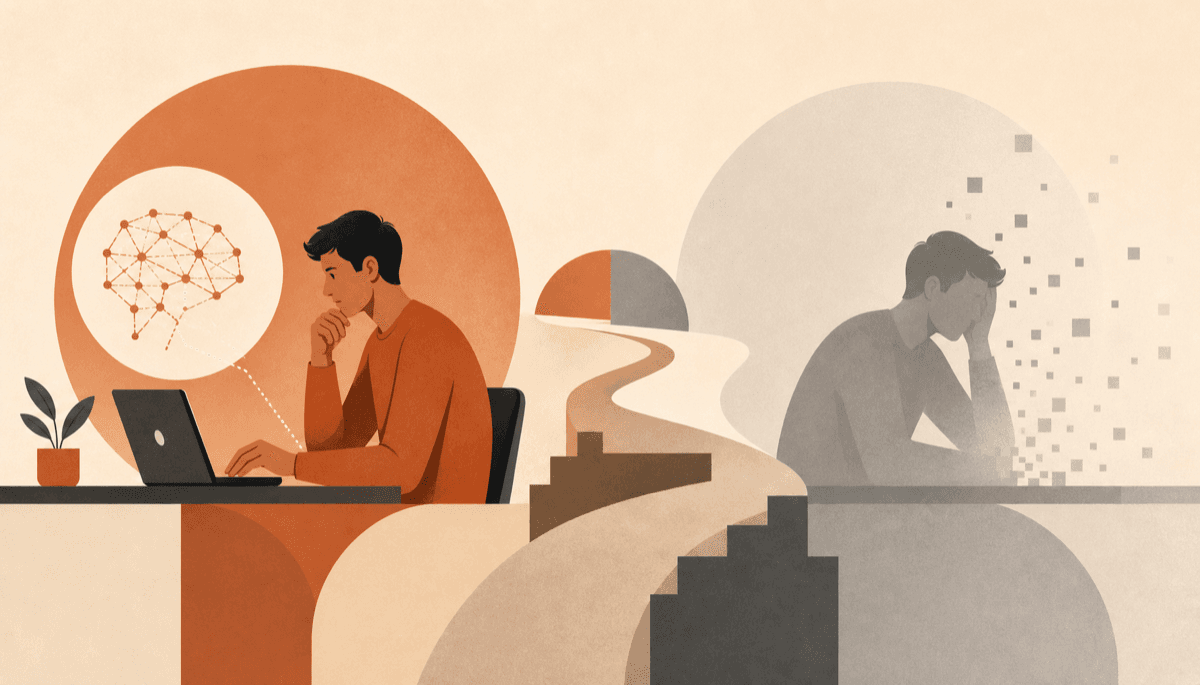
A third-year medical resident can draft a differential diagnosis in seconds with AI assistance. Ask her to do it during a software outage, and she freezes. She has spent three years getting faster at using the tool, not faster at thinking through the case. The diagnosis looks expert. The thinking behind it is not.
This is not a competence problem. It is a practice problem. And it is becoming the defining skill crisis of the decade.
New research published this month reveals a pattern that should alarm anyone who cares about expertise: AI improves your performance while systematically preventing you from building the skill. A large American-British study of 1,222 participants found that using AI to solve arithmetic and reading comprehension tasks produced better results in the moment but worse results over time, along with a reduced willingness to persist when the tool was unavailable. The authors wrote something stark: persistence is foundational to skill acquisition, and it is one of the strongest predictors of long-term learning. AI, in other words, does not just do the work for you. It removes the struggle that makes you capable of doing the work yourself.
This is what researchers are starting to call the never-skilling problem. You get better at tasks with AI. You get worse at them without it. The gap widens until the skill you appear to have and the skill you actually possess are barely related.
Why this is different from calculators and GPS
The obvious comparison is the calculator. Mathematics educators worried for decades that calculators would destroy mental arithmetic. They mostly did not, because a calculator is a narrow tool. It handles computation. It does not handle reasoning, problem formulation, or strategy selection. You still have to understand the problem, set up the equation, and interpret the result.
The same logic applied to GPS. Drivers who use navigation systems do not forget how to drive. They still make every steering, braking, and judgment decision. The GPS handles one narrow task: route calculation.
Spell-check is another useful comparison. It catches errors, but it does not write the sentence. It does not choose the argument, structure the paragraph, or decide which evidence supports which claim. The writer still practices writing. The tool only polishes.
AI is different in kind. As Carnegie Mellon researcher Grace Liu noted, what makes AI particularly concerning is that it is not a tool designated for one specific kind of activity. It is something that can be used across pretty much any intellectual, reasoning, cognitive activity. The calculator left the method and reasoning process in human hands. AI does not. It generates the reasoning, presents it as coherent, and finishes the task before you have encountered any friction at all.
The difference is not convenience. It is developmental. A calculator lets you skip arithmetic while you still practice algebra. A spell-checker lets you skip proofreading while you still practice composition. AI lets you skip the entire chain of reasoning while you still practice prompting. The skill you build is not the skill you need.
The brain is lazy, and AI makes it lazier
Human beings have a strong tendency to save energy, said Johann Chevalere, a cognitive psychology researcher at France's CNRS. In daily life we often use strategies that get us to the heart of the matter quicker, without necessarily taking the time to study in depth the information we need to process, because that is cognitively costly. AI strengthens this tendency dramatically. If there are activities you never do, the brain will not go to the trouble of maintaining connections that are not being used.
This is not metaphor. Neural pathways operate on a use-it-or-lose-it principle. Myelination, the process that insulates neural connections and makes them faster and more reliable, requires repeated activation. The prefrontal cortex, responsible for executive function, working memory, and complex reasoning, develops through sustained effort, not through watching someone else do the work. The frustration of a failed attempt, the reorganization that follows an error, the slow construction of a mental model through trial and correction: these are not glitches in the learning process. They are the learning process.
AI removes all of them. It replaces the slow, error-prone, genuinely difficult process of thinking with a polished, instant, apparently correct output. Your brain registers the result, not the struggle. And since it never experienced the struggle, it never builds the circuitry to handle it.
The persistence finding is the most disturbing part
The American-British study found something worse than declining performance. It found declining willingness. Participants who used AI tools became less likely to keep trying when the tools were unavailable. Not just less capable. Less willing. The psychological muscle that sustains effort through difficulty, the one that separates people who acquire skills from people who abandon them, was itself weakened by AI assistance.
This is the never-skilling mechanism in its purest form. It is not merely that AI prevents you from learning. It prevents you from wanting to learn. The discomfort of not knowing, the itch of an unsolved problem, the stubbornness that makes you try a third approach after two have failed: these are the emotional engines of skill acquisition. AI soothes the itch before you feel it. And without the itch, you do not scratch. And without scratching, you do not build.
A 2025 MIT study found the same pattern in writing. Students who used AI to compose essays displayed measurably less critical thinking capability than students who wrote without assistance. The essays looked better. The thinking behind them was worse. The gap between appearance and substance is the signature of the never-skilling trap.
The seduction of competence
The never-skilling trap is so effective because it feels like competence. You produce expert work. You receive expert feedback. You inhabit the role of an expert. The costume fits so well that you forget it is a costume.
The problem is that competence has two meanings. There is performative competence: the ability to produce good outcomes with the right tools. And there is generative competence: the ability to produce good outcomes from your own resources, under constraint, without assistance. AI creates a reliable illusion of generative competence by providing performative competence so smoothly that the distinction collapses. You do not feel like someone using a tool. You feel like someone who knows the material.
This is why the revelation is so brutal when it arrives. The resident who cannot diagnose without AI. The lawyer who cannot construct an argument without a chatbot. The engineer who cannot debug without autocomplete. The writer who cannot write without a prompt. None of them feel incompetent until the tool is removed. And by then, the years of practice they thought they had accumulated were actually years of tool practice. They are beginners with long resumes.
What this means for knowledge work
The implications are uncomfortable. Consider the professions where AI adoption is deepest: software engineering, law, medicine, journalism, research, policy analysis. In each case, the tool produces faster, more polished output. In each case, the user is practicing prompt engineering, not the underlying craft.
A lawyer who drafts briefs with AI is getting better at generating briefs. She is not getting better at constructing legal arguments, identifying weaknesses in opposing counsel's reasoning, or anticipating judicial questions. A programmer who writes code with AI is getting better at describing desired behavior. He is not getting better at debugging logic, reasoning about edge cases, or understanding why the code works. A journalist who drafts articles with AI is getting better at managing word count. She is not getting better at identifying which sources matter, which questions are uncomfortable, or which narrative frame distorts the truth. The day the AI is wrong, unavailable, or manipulated, the expert is exposed as a beginner wearing expert clothing.
The never-skilling problem is most dangerous in domains where stakes are high and verification is hard. In software, bad code is testable and can be caught. In medicine, a missed diagnosis is not always obvious. In law, a flawed argument might not be challenged until the appeal. In policy, a poorly reasoned position can shape regulation before anyone notices the reasoning was shallow. In journalism, a misleading narrative can travel around the world before the correction catches up. The tool produces confidence faster than it produces competence, and confidence without competence is how disasters happen.
The trap is invisible until it is not
What makes the never-skilling trap so insidious is that it feels like progress. Your output improves. Your speed increases. Your reviews are positive. The feedback loop rewards AI-assisted work because the feedback loop measures output, not internal capability. No one tests whether you can think without the tool. No one asks you to explain the reasoning step by step, because the output is good enough that the reasoning seems irrelevant. The trap closes slowly, and the person inside it does not feel trapped. They feel empowered.
Until the tool fails. Until the internet is down. Until the AI hallucinates. Until the question is novel enough that the training data has no answer. Until the stakes are personal enough that outsourcing the thinking feels wrong. Then the person discovers that the expertise they believed they had was a loan, not an asset. And the creditor is calling.
How to build skills in an age of AI assistance
The solution is not to abandon AI. The tool is too useful, and the competitive pressure to use it is too strong. The solution is to practice deliberately, which means practicing the hard parts, not just the final output.
Here is what deliberate practice looks like in an AI-assisted environment. Before you ask the AI for a draft, write your own. Ask the AI to critique it, not replace it. After you receive the AI output, reconstruct the reasoning yourself, step by step, without looking at the response. When the AI gives you an answer, ask it to explain the opposite position. When you agree with its reasoning, argue against it. Force yourself to find the flaw, the assumption, the unstated premise. Make the AI the sparring partner, not the ghostwriter.
If you are learning to write, disable the AI for your first draft. Use it only for revision. If you are learning to code, solve the problem yourself before you ask the AI for help. If you are learning to reason, construct your own argument before you ask the AI to evaluate it. The goal is not to avoid AI. The goal is to ensure that the AI is enhancing skills you already have, not replacing skills you never built.
The principle is simple: you must maintain contact with the difficulty. The struggle is not an obstacle to the skill. The struggle is the skill. Every time you let the AI remove the struggle, you are choosing to not build the circuitry that struggle would have built. You are choosing to remain competent with the tool and incompetent without it. Over months and years, the compound effect is dramatic. The person who drafts every email with AI and the person who drafts every email themselves do not simply have different workflows. They have different brains. One has strengthened the neural pathways for reasoning, structure, and persuasion. The other has strengthened the neural pathways for prompting. Both feel productive. Only one is building the skill.
For people who want to think clearly, argue well, and develop genuine expertise, the most valuable practice is the practice of resistance. Not because resistance is virtuous, but because resistance is how the brain constructs the structures that make thinking possible. The calculator did not destroy mathematics because it left the reasoning in human hands. The spell-checker did not destroy writing because it left the composition in human hands. AI will not destroy thinking if we leave the reasoning in human hands too. The question is whether we will.
Related Posts
The Rhetoric Hack: How AI Judges Fall for Style Over Substance
New research shows AI peer reviewers can be reward-hacked by rhetorical style alone—no facts changed. What that means for the dream of using AI to evaluate arguments.
The Peer Pressure Machine: How AI Falls for Bad Arguments Under Pressure
New research shows GPT-4o can be talked into abandoning correct answers after just three turns of misleading persuasion. What AI's peer-pressure problem reveals about the skill of thinking for yourself.
The Explanation Trap: How AI Rationales Make Us Stop Thinking for Ourselves
New research shows that AI-generated rationales can degrade human judgment and cause cognitive atrophy. Why explanations that feel like reasoning may be the most dangerous AI output of all.
You just read the argument. Can you make one?
The AI takes the other side, every time. Three rounds, one scored verdict.
Argue today's Daily