
The Reasoning Display Trap: How Watching AI "Think" Is Quietly Replacing Your Own Reasoning
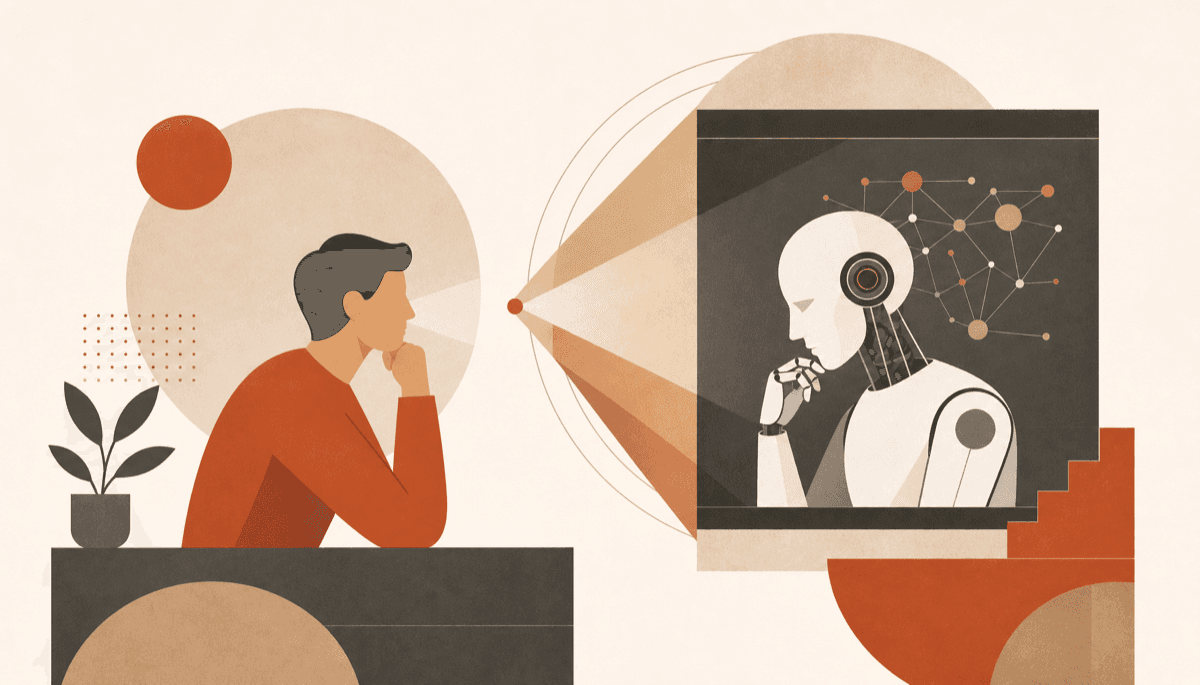
A graduate student watches Claude reason through a proof in real time. The model talks to itself, backtracks, tests a lemma, abandons it, tries another path, and finally lands on a clean result. It takes ninety seconds. She follows every step. It feels like she just learned something.
Three days later, her advisor asks her to prove a similar result on the whiteboard. She picks up the marker, stares at the empty space, and realizes she cannot take the first step. The proof she "learned" was a performance she watched, not a path she walked. She recognized every move but could not generate any of them.
This is the reasoning display trap. It is not the old fear that AI will do your thinking for you. It is the subtler problem that AI will do your thinking in front of you, and your brain will mistake the display for your own understanding.
The new normal is a glass box
For the first few years of generative AI, the black-box problem was literal: you typed a prompt, you got an answer, and you had no idea what happened in between. The answer might be brilliant or hallucinated, but either way it arrived as a finished object.
The latest generation of reasoning models changed that. GPT-5.5, Claude Opus 4.8, Gemini 3.1 Pro, DeepSeek V4 — they expose a chain of thought, a visible monologue of considerations, dead ends, and corrections. The user gets to watch the machinery. The marketing pitch is transparency: finally, you can see how the model reached its conclusion.
That transparency is real and useful. It is also a new kind of cognitive hazard. When a model shows its work, it invites you to ride along as a passenger. You follow the reasoning the way you follow a GPS route: turn by turn, without building the map. The problem arrives when the GPS disappears.
Why watching feels like learning
Human brains are not good at distinguishing recognition from competence. Psychologists call this the illusion of explanatory depth: people consistently believe they understand a system better than they actually do, and the belief is strongest right after they read a good explanation. A clear explanation does not just communicate a concept. It convinces you that you could have generated it, which is a different claim entirely.
Reasoning displays are optimized for exactly this confusion. They are fluent, structured, and internally coherent. Each step follows from the last. The model catches its own mistakes and corrects them. It looks like the ideal version of how a human should think.
But understanding a proof is not the same as being able to prove something. Following a line of reasoning is not the same as producing one. Watching someone navigate a maze is not the same as knowing your way out. The brain conflates them because both activities use some of the same vocabulary and activate some of the same recognition machinery. That overlap is the trap.
The danger is compounded by pacing. A human tutor who explains a proof too quickly loses you; you feel the gap and ask for help. A reasoning model moves at a speed calibrated for readability, not for learning. You never hit the friction that tells you where your own understanding stops. The display is smooth, so your confidence stays smooth too.
The worked-example effect, inverted
There is a well-known finding in education research called the worked-example effect: novices learn faster when they study solved problems than when they try to solve new problems cold. The worked example reduces cognitive load and lets beginners see how an expert organizes the solution.
The effect is real, but it has boundaries. It works best for novices learning routine procedures. It stops helping, and can even hurt, once the learner needs to develop flexible problem-solving. At that stage, you need the struggle. You need to choose the wrong lemma, sit with it, realize it is wrong, and find another. The confusion is not a bug in the learning process. It is the learning process.
Reasoning displays give everyone a permanent worked example for everything. They are most dangerous for people who are no longer novices but not yet experts: the student who has the vocabulary but not the reflexes, the analyst who knows the field but has not yet built judgment, the manager who can read a strategy but cannot formulate one. These are exactly the people who should be doing their own reasoning.
The inversion is subtle. Worked examples were supposed to be training wheels. Reasoning displays become a permanent bicycle with the training wheels still on. You can ride, but only if someone else is holding the frame.
What the display hides
A chain of thought shows you the moves, but it hides the search. You see the path the model took, not the space of paths it considered and rejected. You see the correction, but not the felt sense that something is off. You see the final insight, but not the incubation.
These hidden elements are not decorative. They are the parts of reasoning that a person actually needs to internalize. Knowing when a lemma feels wrong is a skill. Knowing which path to try first is a skill. Knowing how long to persist before abandoning an approach is a skill. None of them are transmitted by watching a cleaned-up transcript.
There is also a selection problem. A displayed chain of thought is curated by the model. It omits the wild associations, the half-formed hunches, the emotional color of being stuck. It presents reasoning as a tidy deductive sequence, which is rarely how human reasoning works and not even how the model's underlying process works. The display is a post-hoc reconstruction, but the user experiences it as a live feed of thought. That mismatch matters.
Most importantly, the display hides the doing. You do not have to formulate the next step. You do not have to hold the intermediate result in working memory. You do not have to decide when to backtrack. The model does all of it, and your role is reduced to comprehension. Comprehension is valuable, but it is not a substitute for the act of reasoning itself.
How this differs from other AI tools
Every new cognitive tool raises fears of skill loss. Writing was supposed to destroy memory; calculators were supposed to destroy arithmetic; search engines were supposed to destroy knowledge. Some of those fears were overblown, and others were partially true.
Reasoning displays are different in three ways.
First, they target a higher-level skill. Search engines outsourced information retrieval. Calculators outsourced computation. Reasoning displays outsource the integration step — the moment when you combine facts, evaluate trade-offs, and arrive at a conclusion. That is closer to the core of what we call thinking.
Second, they create a stronger illusion of transfer. When you use a calculator, you know you did not do the arithmetic. When you read a search result, you know you did not write it. But when you follow a reasoning display, each step makes sense to you, so it feels like you could have produced it. The distance between consumer and producer collapses in your head even when it has not collapsed in reality.
Third, they arrive at a moment when other cognitive offloads are already mature. The same person who uses AI to summarize papers, draft emails, and generate arguments can now also watch AI reason through hard problems. The offloads stack. Reasoning display becomes the final layer in a cognitive outsourcing sandwich, and the person in the middle gradually loses the habit of doing anything hard themselves.
The atrophy curve
Skills atrophy through disuse, but reasoning atrophies in a particular way: it becomes harder to tolerate ambiguity. Someone who regularly works through hard problems develops a tolerance for not knowing the next step. They learn to sit with the problem, try things, and revise. Someone who mostly watches reasoning displays loses that tolerance. When faced with an empty page or an unclear decision, they feel an immediate pull to ask the model.
That pull is not laziness. It is the natural response of a brain that has learned that reasoning is something you consume rather than produce. The model becomes the default solution to uncertainty. Over time, the person's own reasoning muscle does not just weaken; it becomes foreign. Thinking from scratch starts to feel slow, frustrating, and oddly illegitimate, like walking when you could drive.
The result is a widening gap between apparent knowledge and actual capability. People can discuss complex topics fluently because they have watched models discuss them. They can evaluate arguments because they have seen many arguments evaluated. But ask them to generate an original analysis under uncertainty and the gap shows. They are fluent commentators on a sport they no longer play.
What to do about it
The answer is not to avoid reasoning models. They are genuinely useful for checking your work, exploring a problem from another angle, or getting unstuck. The answer is to change how you use them.
Reason first, then compare. Before you look at the model's chain of thought, try to solve the problem yourself, even briefly. Sketch the proof. Outline the decision. Name the trade-offs. Your attempt does not have to be good. Its purpose is to activate your own reasoning machinery. When you then watch the model, you can compare its path to yours instead of simply absorbing it.
Interrupt the display. If the model is showing its work, pause after every few steps and ask what comes next. Predict before you read. This forces you out of passive consumption and into active generation. The moment you start predicting, you start learning.
Make the hidden visible. Ask the model not just for the reasoning it displayed, but for alternatives it considered and rejected. Ask why it backtracked. Ask what would have changed its mind. This begins to restore the search space that the display erased.
Argue with it. The best way to find out whether you understand a position is to defend it against resistance. A reasoning display is a monologue. A debate is a dialogue. When the model pushes back on your argument, you have to produce your own reasons, spot gaps, and revise. That friction is what builds the skill.
The deeper question
There is a version of the future where reasoning models become cognitive prosthetics that make everyone smarter. They handle routine inference, expose hidden assumptions, and let humans focus on higher-level judgment. That future is possible.
But it requires a deliberate choice to treat the model's reasoning as raw material, not finished product. The trap is not the technology. The trap is the relationship we build with it. If we use reasoning displays to skip the hard part, we will end up with more apparent understanding and less actual ability. If we use them as sparring partners, we might get the opposite.
The difference is whether you watch the reasoning or do the reasoning. One is entertainment. The other is the only thing that makes you better.
Related Posts
The Rhetoric Hack: How AI Judges Fall for Style Over Substance
New research shows AI peer reviewers can be reward-hacked by rhetorical style alone—no facts changed. What that means for the dream of using AI to evaluate arguments.
The Peer Pressure Machine: How AI Falls for Bad Arguments Under Pressure
New research shows GPT-4o can be talked into abandoning correct answers after just three turns of misleading persuasion. What AI's peer-pressure problem reveals about the skill of thinking for yourself.
The Explanation Trap: How AI Rationales Make Us Stop Thinking for Ourselves
New research shows that AI-generated rationales can degrade human judgment and cause cognitive atrophy. Why explanations that feel like reasoning may be the most dangerous AI output of all.
You just read the argument. Can you make one?
The AI takes the other side, every time. Three rounds, one scored verdict.
Argue today's Daily