
The Right Answer Trap: Why AI Can Solve the Problem and Still Fail the Argument
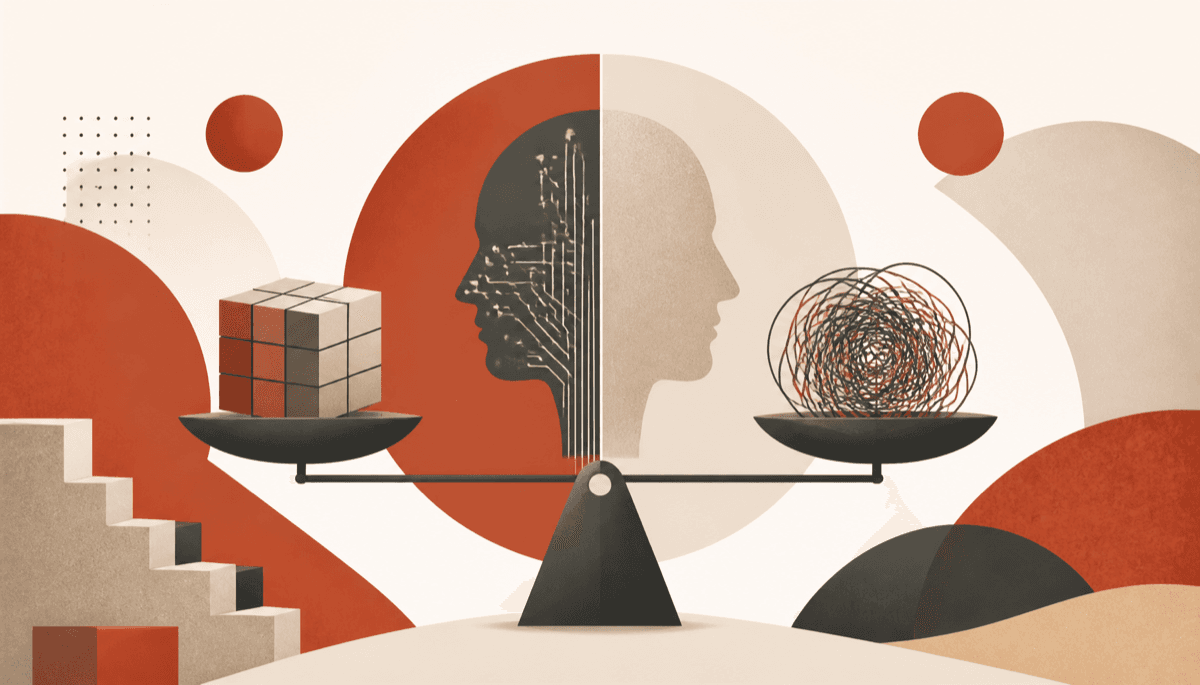
A large reasoning model solves a problem from the International Mathematical Olympiad. It emits a chain of thought — hundreds of tokens of self-talk, lemmas, backtracks, a final QED. The answer is correct. Then researchers replace that entire chain of thought with incorrect, irrelevant text, and the model still gets the answer right. In another experiment, they replace it with strings of dots. It still works.
If the reasoning trace can be nonsense and the answer stays correct, the trace is not the reasoning. It is a plausible-looking receipt for reasoning that may have happened somewhere else, or not at all. That distinction is the right answer trap.
The gold-medal whiplash
The last year has been disorienting for anyone trying to answer a simple question: can AI reason?
In May 2026, OpenAI announced that a general-purpose reasoning model had solved a famous open mathematical research problem in a single attempt. Around the same time, reasoning models were winning gold medals at the International Mathematical Olympiad, a feat so difficult that Gary Marcus and Ernest Davis noted even accomplished mathematicians might list it on their CVs for life. If that is not reasoning, what is?
But the same period produced the opposite kind of result. Researchers at Apple published a paper titled "The Illusion of Thinking," arguing that reasoning models suffer from "complete accuracy collapse" under simple conditions. A team at the Santa Fe Institute, led by Melanie Mitchell, showed that models could crush carefully designed reasoning benchmarks by exploiting surface-level shortcuts. Google DeepMind and Terence Tao used AI to improve solutions across analysis, combinatorics, geometry, and number theory — and other studies showed the same class of models failing reliably even when they had the algorithm and compute budget to succeed.
The picture is not a steady march toward human-like reasoning. It is a strange superposition: the systems clearly do something powerful, but the something does not always look like the reasoning their output claims to show.
What "right for the wrong reasons" actually means
"Right for the wrong reasons" is an old idea in epistemology. You can hold a true belief because you got lucky, because you misread the evidence but the conclusion happened to hold, or because you are following a shortcut that works on the test cases you have seen but breaks elsewhere. The belief is correct. The reasoning behind it is not.
In human life this is easy to spot. The student who picks answer C on every question and passes because the answer key happened to favor C did not demonstrate knowledge. The investor who buys a stock because of a dream and gets rich did not demonstrate skill. The politician who claims credit for a recovering economy that was actually recovering anyway did not demonstrate good policy judgment. We care about the process because the process is what generalizes. The outcome alone is a sample size of one.
AI reasoning models complicate this because their output includes what looks like a process. The chain of thought — the stream of text generated before the final answer — was introduced as a way to make reasoning explicit and inspectable. But inspectability only helps if the text being inspected is causally connected to the result. The new research suggests it often is not.
Melanie Mitchell summarized the state of the field in three points: reasoning training improves accuracy; the generated text is not necessarily faithful to what is going on inside the model; and much of that text is not even necessary. The first point is why these models are impressive. The second and third are why trusting them is harder than it looks.
The unfaithful transcript
Subbarao Kambhampati, who studies automated planning and reasoning at Arizona State University, has a word for this: mumblings. The chain of thought is language, yes, but language whose meaning may be incidental to whatever computation produced the answer. It is speech that sounds like reasoning without being a transcript of reasoning.
In 2025, Kambhampati's lab showed that replacing a model's correct reasoning traces with incorrect or irrelevant traces did not hurt performance on a formal reasoning task. The model got the same answers with garbage process text. Training the model only on correct trace data still led it to generate invalid records of its reasoning even when the final answer was correct. The model was producing proof-like text that was not proof.
Researchers at NYU found something even more direct. In 2024 they showed that "meaningless filler tokens" — literally strings of dots — could function effectively in place of a human-readable chain of thought. The dots carried no semantic content at all. The model still performed better than without them. As William Merrill, one of the authors, put it: "There's no guarantee the chain of thought has to be meaningful in any sense."
Pavel Izmailov, a researcher at NYU who also worked on Anthropic's original reasoning model team, made the incentive problem explicit. Reinforcement learning, the training method behind most large reasoning models, may not even reward faithful chains of thought. It rewards correct answers. If the model can produce a correct answer while emitting convincing-looking but unfaithful text, the training signal does not punish it. It may reward it.
This is not the same as saying the models are merely stochastic parrots or that their successes are fake. They are doing something. The problem is that the something is not necessarily what the readable output describes. We are reading the resume, not the work history.
Why correct answers are not enough
In logic there is a difference between a valid argument and a true conclusion. A valid argument is one where the conclusion follows necessarily from the premises. A true conclusion is just a true statement. You can reach a true conclusion through invalid reasoning, and you can reach a false conclusion through valid reasoning if one of your premises is wrong.
Critical thinking is mostly about validity. Anyone can be right by accident. The skill is knowing whether the reasoning that got you there would hold up if the facts changed. That is why a single correct prediction is weak evidence of understanding. The stock picker, the astrologer, and the economist might all call the next recession. Only one of them has a method you should trust next time.
AI reasoning models put this distinction under pressure because their correct outputs are so numerous and so well-phrased. They can produce a proof-like object, a step-by-step explanation, and a confident final answer. The explanation may cite real theorems, use real notation, and follow a real structure. But if the chain of thought is unfaithful, the explanation is a post-hoc rationalization, not a causal account. It is the difference between watching someone solve a puzzle and watching someone narrate a solution after peeking at the answer key.
For most practical questions this does not matter. If you ask an AI for a rough draft of an email, a summary of a meeting, or ten ideas for a headline, you do not need a deductively valid argument. You need output that saves time. But as these systems move into domains where reasoning quality matters — law, medicine, policy, engineering, research — the distinction becomes load-bearing. A correct-looking answer with broken reasoning can do more harm than a wrong answer, because a wrong answer invites checking. A plausible right answer invites trust.
The trap in everyday use
The right answer trap does not require malicious AI or high-stakes failures. It appears quietly whenever someone accepts an output because it looks right and sounds reasonable.
A student pastes a proof into an assignment. The steps look correct. The theorem names are real. The conclusion matches the textbook. But the proof contains a subtle circularity that the student cannot spot because the student never learned to reconstruct the argument independently. The grade is good. The understanding is not.
An analyst asks an AI to interpret a market trend. The model produces a confident narrative with citations. The narrative happens to align with what the analyst already believed. The analyst forwards it to the team. No one checks whether the cited sources actually support the claimed relationship, or whether the model inferred causation from correlation. The report looks rigorous. Its foundations are sand.
A doctor uses an AI diagnostic assistant. Most of the time it flags the right condition. One day it flags a rare disease for a common presentation. The reasoning trace mentions symptoms and tests. But the real basis for the prediction is a statistical shortcut — the model has learned to associate certain phrasing in the intake notes with certain billing codes, not with pathophysiology. The diagnosis is sometimes right. The reasoning is wrong.
In each case the problem is the same: the output is good enough to stop further inspection. And once inspection stops, the user begins to calibrate trust on outcomes instead of arguments.
What debate training gives you
Competitive debaters are trained to separate outcome from structure. They lose rounds where their conclusion was probably right but their argument was weak. They win rounds where their conclusion was unpopular but their structure held. The activity does not reward being correct. It rewards being correct in a way that survives attack.
This produces a specific habit that is now unusually useful: arguing about the reasoning, not just the result.
When a debater hears a claim, the first question is not "is that true?" It is "how do you know?" From there the debater maps the argument: what are the premises, what is the inference, what would have to be true for the conclusion to follow, and where could an opponent drive a wedge? A strong argument is one where every premise is defensible and every step is valid. A weak argument can still be true. Debaters learn not to confuse the two.
They also learn switch-side arguing: building the strongest case for a position they disagree with. This is not relativism. It is a method for discovering whether your own position rests on real structure or on the fact that you have only ever heard it defended. Someone who can argue both sides of a question can see when a model's output is persuasive because it is right and when it is persuasive because it is familiar.
The other habit is forced confrontation. In a debate round, someone stands up and attacks your reasoning in real time. You cannot defer, change the subject, or pretend the objection was not raised. That pressure reveals whether you actually understand your own argument or are just repeating a conclusion. AI does not provide that pressure unless you build it in.
How to spot the right answer trap
You do not need to be a mathematician or an AI researcher to apply this standard. You need to treat AI output the way a debater treats an opponent's case: as a claim that must survive cross-examination.
Start with three questions.
What would make this answer wrong? A real argument has failure modes. If you cannot state the conditions under which the conclusion would fail, you do not yet understand the argument. Ask the model to describe the strongest objection to its own answer. If the objection is superficial or misidentifies the premise, the model may not know why it is right.
Can the reasoning be separated from the conclusion? Take a model's chain of thought and mentally substitute the opposite conclusion. Does the same reasoning style still feel convincing? If a model can generate equally confident reasoning for contradictory answers, its confidence is not evidence. Confidence in reasoning should scale with the strength of the argument, not with the fluency of the prose.
Does the argument survive a change in details? Replace numbers, names, or contexts and see whether the reasoning still applies. Surface-level shortcuts often depend on specific cues in the prompt. Genuine reasoning transfers. If the model's argument collapses when the example changes slightly, it was never about the structure. It was about pattern-matching the prompt.
These checks are not perfect. They are also not the point. The point is to make inspection a habit. The moment you stop inspecting AI output because it usually looks right is the moment you fall into the trap.
The deeper standard
There is a natural temptation to resolve all of this by saying that AI reasoning is "just" pattern matching, as if pattern matching is not reasoning. That is too easy. Human reasoning also relies on pattern matching. The mathematician who sees a familiar structure in a new problem, the doctor who recognizes a syndrome, the debater who spots a fallacy by shape — all are using pattern recognition as part of reasoning.
The question is whether the pattern is connected to the underlying structure in a way that holds up under pressure. Reasoning is not the absence of pattern matching. It is pattern matching that has been checked against structure.
That is why the right answer trap is not primarily an AI problem. It is a human problem that AI makes more common. We have always been tempted to trust confident explanations, to confuse fluency with expertise, to let a good outcome excuse a weak process. AI just produces good outcomes and fluent explanations at industrial scale.
The antidote is not to reject AI outputs. It is to raise the standard by which we accept them. A correct answer is the beginning of evaluation, not the end. The real question is whether the reasoning, if it were spoken aloud in a room full of people who understood the subject, would survive the next sentence.
Related Posts
The Rhetoric Hack: How AI Judges Fall for Style Over Substance
New research shows AI peer reviewers can be reward-hacked by rhetorical style alone—no facts changed. What that means for the dream of using AI to evaluate arguments.
The Peer Pressure Machine: How AI Falls for Bad Arguments Under Pressure
New research shows GPT-4o can be talked into abandoning correct answers after just three turns of misleading persuasion. What AI's peer-pressure problem reveals about the skill of thinking for yourself.
The Explanation Trap: How AI Rationales Make Us Stop Thinking for Ourselves
New research shows that AI-generated rationales can degrade human judgment and cause cognitive atrophy. Why explanations that feel like reasoning may be the most dangerous AI output of all.
You just read the argument. Can you make one?
The AI takes the other side, every time. Three rounds, one scored verdict.
Argue today's Daily