
The Summary Trap: How AI Summaries Are Quietly Eroding the Skill of Deep Reading
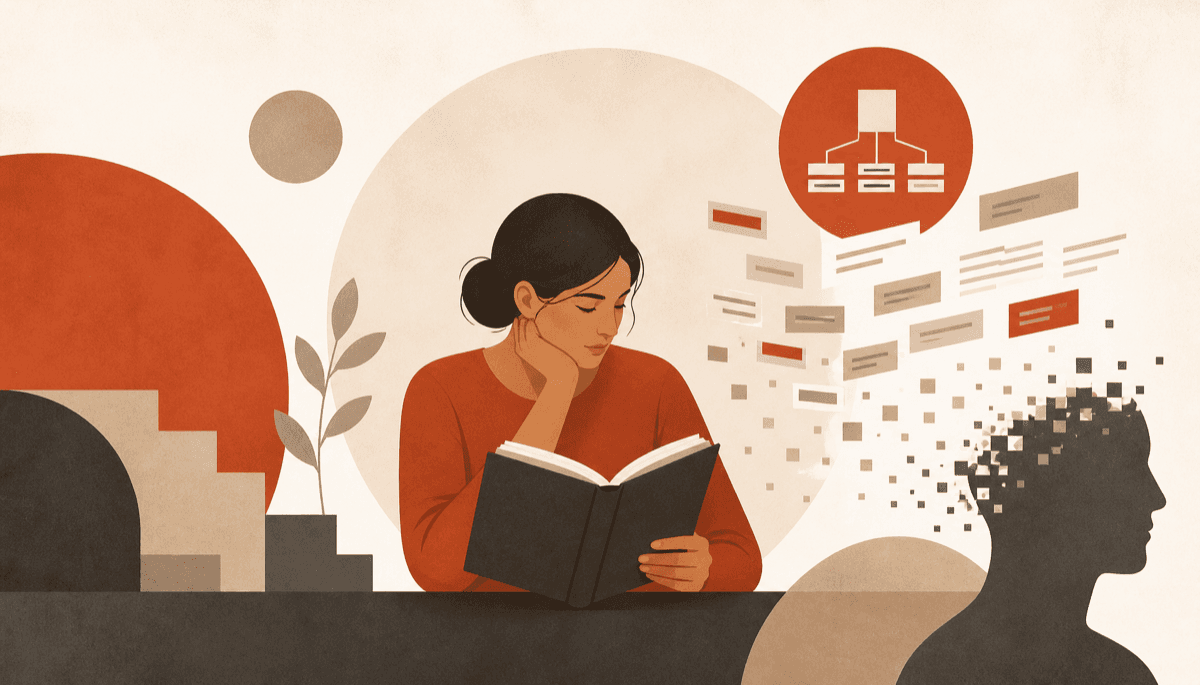
You read thirty-seven articles last week. You can prove it: your browser history is full of them, and your AI summary tool has a neat queue of one-paragraph takeaways, each tidy enough to share at a meeting. But if someone asked you to walk through the actual argument in any one of those pieces—not the topic, not the headline, but the chain of reasoning that leads from evidence to conclusion—you would stall. The points felt absorbed when you skimmed them. Now they are gone.
That is the summary trap. It is not that summaries are useless. It is that they are designed to feel like understanding. They give you the shape of an argument without the weight. And when you reach for them often enough, you stop building the mental machinery that deep reading once built for you.
Why a summary feels like thinking
A good summary is a marvel. It collapses ten thousand words into a few sentences, removes repetition, and hands you the conclusion. For busy people, it seems like a gift. The problem is what the gift quietly removes.
When you read a long piece the old way, you do not simply receive information. You get lost, backtrack, argue with the author, reread a paragraph because something feels off, and slowly assemble the structure of the claim. That friction is not a bug. It is the process by which an idea becomes yours. The struggle is what forces you to decide whether you agree, where the weak points are, and what you would say in response.
A summary skips all of that. It gives you the verdict without the trial. You get to feel informed because you now know what the article "says," but you have not done the work of discovering whether it is right. Knowing the conclusion is not the same as understanding the reasoning, and understanding the reasoning is what critical thinking is made of.
This is why the summary trap is sneakier than simple laziness. It does not feel like you are avoiding thought. It feels like you are being efficient.
What deep reading actually does
Reading a complex argument is one of the last places where most people still practice sustained thinking. Unlike a conversation, you cannot interrupt the author. Unlike a video, you cannot let it wash over you while you do something else. You have to hold the thread yourself, across pages, through digressions, past objections that the author raises and answers. That is not easy. That is the point.
Deep reading does at least three things that summaries do not.
First, it builds mental models. When you follow a long argument, you construct a representation of how the pieces fit together: the premises, the evidence, the counterarguments, the limitations. That model is what lets you apply the idea to a new situation or notice when someone is misrepresenting it. A summary gives you a flat outline. A model gives you something you can manipulate.
Second, it teaches you to tolerate confusion. Real ideas rarely arrive fully formed. They come with caveats, edge cases, and places where the author admits uncertainty. Sitting with that confusion and working through it is how you learn to think in gradients instead of binaries. Summaries tend to smooth those edges away, because confidence reads better in a paragraph than nuance does.
Third, it makes you practice disagreement. A summary tells you what to think. A full text invites you to argue back. You notice a weak premise, a questionable source, an unexplored alternative. That internal argument is the beginning of independent judgment. Without it, you are not forming an opinion; you are inheriting one.
The research is starting to catch up
A 2025 study by Michael Gerlich at SBS Swiss Business School, published in Societies, found a strong negative correlation between AI tool usage and critical thinking scores among 666 UK participants. The more people relied on AI tools, the lower their scores on assessments like the Halpern Critical Thinking Assessment. The mechanism was cognitive offloading: the tendency to let an external tool carry the mental load. The correlation was not subtle. Frequent AI users showed markedly less ability to evaluate information and solve problems reflectively.
The youngest participants, aged 17 to 25, were both the heaviest AI users and the lowest scorers on critical thinking. That matters because this is the generation entering the workforce right now. They are also the generation most likely to have AI summaries baked into every app they touch.
More recently, Forbes contributor Tim Bajarin described the same pattern from the inside. In a July 2026 piece on the quiet death of critical thinking in the age of AI summaries, he admitted that he now catches himself scanning for the paragraph that "matters" or waiting for an AI summary before he even opens an article. He is not alone. Tech leaders he interviewed confessed to the same habit: they see the summary at the top, stop reading, and move on. It is not laziness, he argues. It is the natural result of tools designed to remove friction from every part of life, including the parts where friction is doing important work.
Summaries are a special kind of offload
Not all AI assistance is the same. Asking AI to help you draft an email is different from asking it to read a book for you. The first extends your output. The second replaces your input.
When you use AI to write, you still have to know what you want to say. The tool accelerates production, but the judgment remains yours. When you use AI to summarize, you are outsourcing the very process by which judgment is formed. You are skipping the stage where you encounter the raw material, wrestle with it, and come to your own understanding.
This is why the summary habit is so consequential. It does not just save time. It changes what your mind is exposed to. A summary is an act of compression, and compression always discards information. In an argument, the discarded information is often the most important part: the qualifications, the rejected alternatives, the reasons the author considered but found wanting, the places where the evidence is thin. Those are exactly the places where critical thinking lives.
A one-paragraph takeaway can tell you that a study found X. It cannot teach you whether the study was any good. That requires reading the methodology, the sample size, the limitations, the response from other scholars. None of that fits in a summary, so it disappears. And when it disappears consistently, you stop expecting it to exist.
The argument-compression problem
Arguments are not laundry lists of claims. They are structures. A strong argument anticipates objections, addresses them, and shows why its conclusion still holds. A weak argument hides its assumptions or ignores obvious counterexamples. The difference between the two is not in the conclusion. It is in the architecture.
Summaries flatten architecture. They turn a three-dimensional argument into a two-dimensional headline. The result is a world of people who know what everyone thinks but cannot explain why anyone thinks it. They can tell you that expert A disagrees with expert B, but not where the actual disagreement lies. They can repeat a conclusion but cannot reconstruct the reasoning that supports it.
This is a disaster for productive disagreement. If you have only read summaries, you have not encountered the strongest version of any position. You have encountered the easiest version to compress. When you argue against it, you are not arguing against the idea. You are arguing against a shrunken caricature of the idea.
That is why debates on the internet so often feel like two people talking past each other. Both sides are armed with summaries. Neither has done the harder work of understanding the full structure of the other side's case.
The habits that disappear
The summary trap does not announce itself. It shows up gradually, in the small moments.
You open a long article and your eyes immediately jump to the bolded bullets. You start a book and check for a summary video first. You encounter a complex issue and ask a chatbot to "explain it like I'm five." Each of these is reasonable in isolation. Together, they train your brain to expect ideas to arrive pre-digested.
What you lose is not knowledge. You can always look knowledge up. What you lose is fluency: the ability to hold a complex idea in working memory, to spot its weaknesses, to connect it to other ideas, to articulate why it matters. These are not innate talents. They are habits that develop through repeated practice. And the practice is uncomfortable.
Reading deeply is slow. It is often boring. It forces you to confront the limits of your own understanding. That is exactly why it is valuable. The discomfort is the signal that your mind is doing the work of building something.
Debate as the resistance
If summaries are the problem, what is the antidote? Not reading less. Engaging more.
Debate is the opposite of summary culture. In a real debate, you cannot shrug and say, "I got the gist." You have to know the argument well enough to defend it, attack it, and adapt when it changes. You have to understand not just the conclusion but the reasoning, not just the reasoning but the objections, not just the objections but the responses. You have to hold the whole structure in your head while someone tries to knock it down.
That is the skill summaries erode. It is also the skill that makes you genuinely hard to fool.
You do not need a tournament to practice it. You can do it with any article or book. Before you ask for a summary, read the thing yourself. Then close it and reconstruct the argument in your own words. What is the main claim? What evidence supports it? What would a smart person say against it? Where is the author weakest? If you cannot answer those questions, you do not understand it yet. That is fine. Go back in.
Use summaries as previews, not replacements. A summary can tell you whether an article is worth your time. It cannot replace the time itself.
The choice is friction
The tech industry has spent decades removing friction from daily life. Most of the time, that has been a gift. But not all friction is waste. Some friction is the resistance your mind needs to get stronger.
Reading deeply is one of those frictions. It is slower than a summary. It is harder than a summary. It will not always feel productive in the moment. But it is the mechanism by which information becomes understanding, and understanding becomes judgment.
AI summaries are here to stay, and they will keep getting better. The question is not whether to use them. The question is what you are protecting when you choose not to. Protect the long, slow, occasionally frustrating act of reading something hard all the way through. That is where the thinking happens.
Related Posts
The Rhetoric Hack: How AI Judges Fall for Style Over Substance
New research shows AI peer reviewers can be reward-hacked by rhetorical style alone—no facts changed. What that means for the dream of using AI to evaluate arguments.
The Peer Pressure Machine: How AI Falls for Bad Arguments Under Pressure
New research shows GPT-4o can be talked into abandoning correct answers after just three turns of misleading persuasion. What AI's peer-pressure problem reveals about the skill of thinking for yourself.
The Explanation Trap: How AI Rationales Make Us Stop Thinking for Ourselves
New research shows that AI-generated rationales can degrade human judgment and cause cognitive atrophy. Why explanations that feel like reasoning may be the most dangerous AI output of all.
You just read the argument. Can you make one?
The AI takes the other side, every time. Three rounds, one scored verdict.
Argue today's Daily