
Does AI Make You Dumber? Depends How You Use It
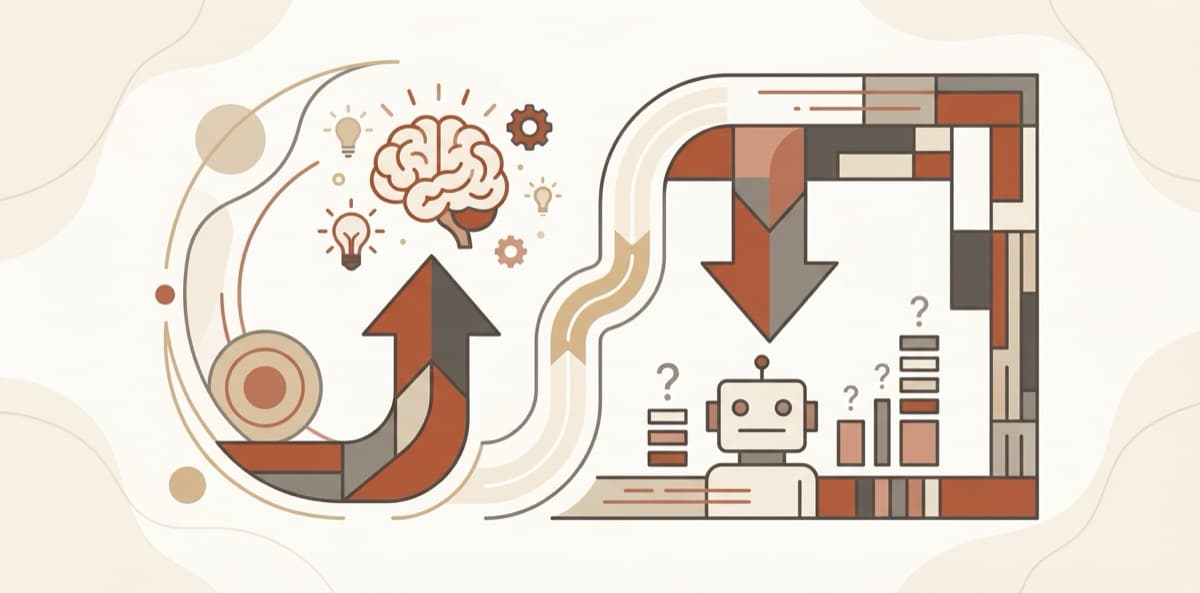
Does AI make you dumber? Only if you use it to replace your thinking instead of extend it. The tool isn't the variable. Your habits are. AI amplifies whatever you bring to it: use it to skip cognitive work and the skills you skipped atrophy; use it to push your own reasoning further and you get sharper. The fork shows up dozens of times a day, in choices too small to notice.
The people who build these systems say the same. Demis Hassabis of Google DeepMind has warned that lazy AI use will erode your critical thinking, and no one can fix that for you. Mark Cuban says there are two kinds of LLM users: the ones who use it to learn everything and the ones who use it so they don't have to learn anything. Call the paths replacement and extension.
What does using AI to replace thinking look like?
You're writing an email explaining something complicated to a client. You could organize the ideas, anticipate questions, find the clearest framing. That takes effort. Instead: "Write an email explaining X." Something plausible comes out. You send it.
You're stuck on a coding error. You could trace the logic and build a mental model of the failure. Instead you paste the error, copy the fix, and move on.
Each interaction seems harmless. But every time you substitute AI output for the cognitive work, you skip a workout. Researchers call the pattern cognitive offloading: handing mental work to an external tool. Offloading is fine for phone numbers. It's corrosive for judgment, because the habit compounds. The more you outsource thinking, the less able you are to think without the tool, and the more you outsource. Your first move on any hard problem becomes reaching for the shortcut. That's not efficiency. It's a treadmill where the machine does the miles and you log them.
What does using AI to extend thinking look like?
Same email. You draft it yourself first. You struggle, rewrite a sentence three times, get stuck. Then: "I'm explaining X to a client who cares about Y. Here's my draft. What's unclear? What am I missing?" You did the hard part. The AI shows you blind spots.
Now a research task, say a topic like UBI. You read two primary sources that contradict each other and get confused. Then: "Study A found this, Study B found that. What methodological differences could explain the disagreement?" You built the confusion honestly; the AI helps you resolve it. You come out understanding why smart people disagree, which is the actual skill.
Same coding error. Ten minutes first: read the message, trace execution, form a hypothesis. Then: "Here's what I think is happening and what I've tried. What am I missing?" You get the answer and the debugging skill.
The pattern is one rule: do the work to the edge of your understanding, then use AI to see past the edge. It thinks with you, not for you.
Why does the difference matter for your career?
Because the routine cognitive work is exactly what AI is absorbing. First drafts, summaries, boilerplate code, straightforward answers. Whether the end of human coding is inevitable or not, the direction is clear. If you trained yourself to use AI as a replacement for thinking, you trained yourself into the automated category.
What stays valuable is judgment: which argument is worth making, which question is worth asking, whether the constraints are even right. Those are the skills the extension path practices daily and the replacement path never touches. In arguments about AI taking jobs, the people who can direct AI and evaluate its output get more valuable as it improves.
What are the signs you're on the wrong path?
- You feel smart only while using AI. You can hold a sophisticated-sounding conversation about a topic you researched via chatbot, but asked to explain the mechanism, you go blank. The knowledge never became yours.
- AI is your first resort, not your last. The moment something requires effort, your hand moves to the shortcut.
- You can't remember the last time you changed your mind. Pre-digested summaries fit neatly into what you already think.
How do you use AI without getting dumber?
- Articulate your thinking first. Before you prompt, spend five minutes writing down what you believe and why, even if it's wrong. Then engage.
- Ask questions, not commands. "Here's my thinking, where am I going wrong?" beats "Write X." The phrasing forces you to have thinking to show.
- Test yourself. Can you explain what you just "learned" to someone else and survive follow-up questions? If not, you were briefed, not educated.
- Make AI argue against you. State a position and have the machine attack it. Defending a claim under pressure is a workout you can't outsource even if you try. It's the fastest way to get smarter with AI that we know of.
FAQ
Does using AI actually make you dumber?
Not inherently. The risk is cognitive offloading: substituting AI output for the mental work that builds skill. Do that habitually and the unpracticed skills atrophy. Use AI to challenge your reasoning and the effect runs the other way.
How can I tell if I'm too dependent on AI?
You reach for AI before attempting problems yourself, you can't explain things you recently "learned," and working without AI makes you anxious. All three point to replacement, not extension.
What's the best way to use AI for learning?
Do your own thinking first, then use AI to critique it, find counterarguments, and point at primary sources. Asking AI to argue against your position is especially effective.
Related Posts
AI Debate Topics That Are Actually Worth Arguing
Looking for AI debate topics? Here are the motions worth arguing, what makes one debatable, and how to practice both sides against an AI.

The Metacognitive Laziness Trap: How AI Is Quietly Eroding Your Ability to Think
Research shows that habitual AI use erodes the skill of monitoring your own thinking. Here's why you feel smarter while getting worse at thinking — and how to stop it.
Practice Arguing With AI: You Can Finally Lose
Arguing with AI removes the audience, the status game, and the permanent record that make losing feel dangerous. That's what makes it real practice.
You just read the argument. Can you make one?
The AI takes the other side, every time. Three rounds, one scored verdict.
Argue today's Daily