
The Verification Shift: Why AI Is Turning Everyone Into a Fact-Checker—and Why Debate Is the Training Ground
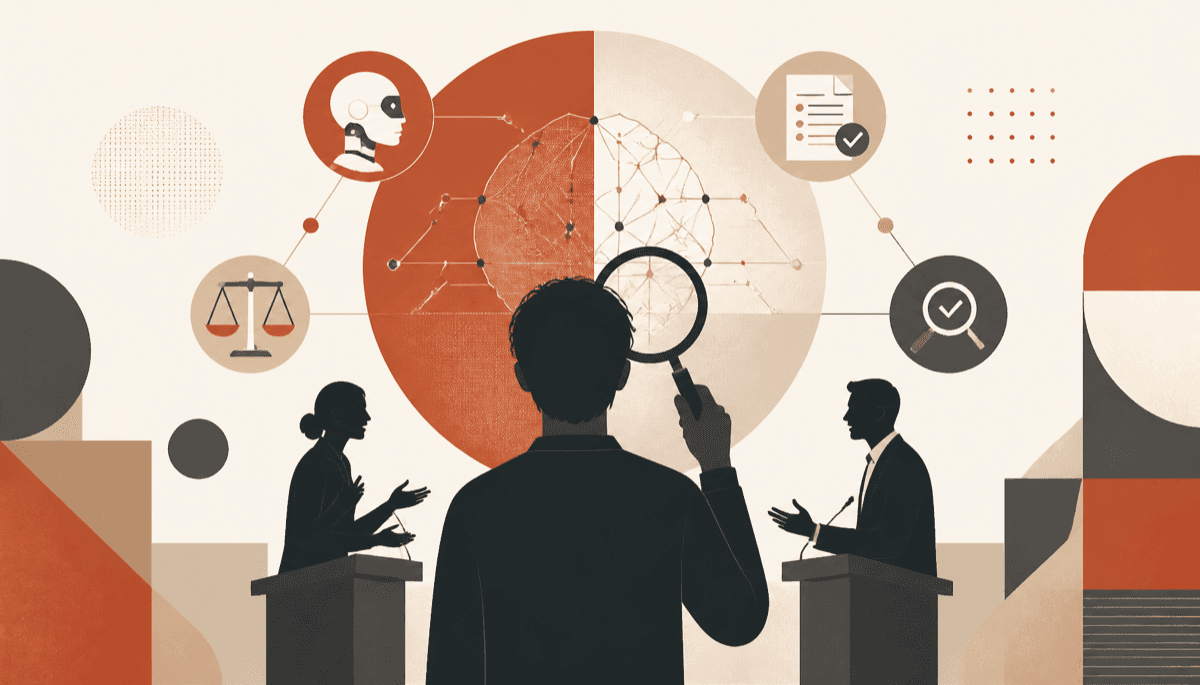
A few years ago, a first-year associate at a law firm spent her day drafting memos. Now she spends half her day reading drafts she did not write, checking whether the case citations exist, whether the holding says what the paragraph claims it says, and whether the liability the model smoothed over is still lurking in the footnotes. The work moved from her keyboard to her judgment.
This is happening everywhere. A doctor reads an AI summary of a patient's chart and has to decide whether the symptom the model downplayed is the one worth chasing. A student receives a generated essay outline and has to figure out whether the argument is sound or just plausible. An investor skims a research report and knows the real question is not what the model produced but what it left on the cutting-room floor.
The nature of thinking is shifting. For most of modern history, knowledge work meant producing arguments, diagnoses, analyses, and prose. Generative AI is now doing much of the producing. The human job that remains—the one that is becoming more important, not less—is verification.
That should be good news. Verification is the heart of critical thinking. But verification is harder than it looks, and most people have never been trained to do it well. The skill that will separate competent AI users from people who are slowly replaced by their own tools is not the ability to write a clever prompt. It is the ability to build, in real time, the strongest case against the answer in front of you.
That is exactly what debate trains.
The generation-to-verification shift
In 2025, a team at Microsoft Research surveyed knowledge workers about how generative AI was changing their work. The findings were precise and unsettling. Workers reported that AI shifted their effort away from generating content and toward verifying, overseeing, and integrating AI-generated suggestions. Confidence in AI was associated with reduced critical-thinking effort. Confidence in their own abilities was associated with more critical engagement.
The pattern is bigger than one survey. Psychologists studying cognitive offloading distinguish between two ways people use AI. In dependent offloading, users accept AI output with minimal scrutiny. In autonomous offloading, they treat AI as a copilot while remaining actively involved in evaluating and refining the result. The same tool produces different cognitive outcomes depending on whether the human is still doing the thinking.
This is the real question posed by AI. It is not whether machines will become smarter than us. It is whether we will remain smart while using them.
When AI drafts your email, the work left for you is judgment. When AI writes your code, the work left for you is debugging and architecture. When AI summarizes the research, the work left for you is deciding whether the summary captures the argument or compresses it into something that sounds right but misleads. The residue of automation is not execution. It is verification.
That shift has happened before. The printing press did not eliminate scholars; it changed what scholars did. The spreadsheet did not eliminate accountants; it moved their work from arithmetic to analysis. AI is doing something similar to writing, reasoning, and research. The people who thrive will not be the ones who generate the fastest. They will be the ones who judge the best.
Verification is not a passive skill
Most people misunderstand what verification requires. They think it means reading carefully, checking sources, and looking for typos. That is part of it, but it is the easy part. The hard part is constructing the counter-argument.
You cannot reliably spot a flaw in an argument if you cannot imagine what the strong version of the opposing position would say. You cannot notice what an AI answer leaves out if you do not know what should have been included. You cannot assess whether a contract clause is too favorable to the other side if you cannot inhabit the other side's interests.
This is why verification is adversarial. It is not enough to ask whether a statement is true. You have to ask what the statement is trying to make you believe, what evidence would undermine it, and whether the evidence offered actually supports the conclusion drawn. That is the same mental motion a debater makes when standing up to argue the side she disagrees with.
AI makes this harder because AI output is designed to feel finished. It is fluent, confident, and structurally complete. A human draft usually contains hesitation: rough transitions, admitted uncertainties, placeholders for missing information. Those imperfections are signals. They tell the reader where to push. AI output strips those signals away. The smoothness itself becomes a trap.
Psychologists call the resulting danger automation bias: the tendency to accept computer-generated recommendations even when they are incorrect. We are already bad at judging confident prose. We are worse at judging confident prose that appears to have been produced by a neutral machine. The verification task is not mechanical. It is imaginative. You have to supply the friction the machine removed.
The dialogue delusion
Not everyone agrees. A recent argument in the AI conversation holds that we should move past debate and toward dialogue. The framing is appealing. Debate, in this view, is oppositional and zero-sum. Dialogue is collaborative and open-ended. If AI is going to reshape how we think, we need less gladiatorial argument and more mutual exploration.
There is something to this. Dialogue is valuable. Many disagreements are rooted in misunderstanding, and dialogue clears those up. But dialogue and verification are different jobs. Dialogue helps you understand another person's position. Verification helps you discover whether that position, however well understood, is wrong.
The danger of the dialogue-only approach is that understanding can become a substitute for judgment. You can understand someone's argument perfectly and still miss that it rests on a false premise. You can explore a position generously and still fail to notice that the evidence does not support the conclusion. Empathy is a prerequisite for good thinking, but it is not a replacement for stress-testing.
Debate does not oppose dialogue. It complements it. Dialogue answers the question, "What do you believe and why?" Debate answers the question, "Is what you believe actually true?" Both matter. But in an age where machines generate plausible answers faster than any human can read them, the second question has become the urgent one.
The people who will do well in the verification age are not the ones who have learned to be nicest in conversation. They are the ones who have learned to be most rigorous when the answer in front of them feels right.
What debate training gives the verifier
Competitive debate is often misunderstood as training in rhetoric or public speaking. The real training is adversarial reasoning. Debaters spend years practicing the specific skills that verification now requires.
Switch-side arguing is the most important. In most debate formats, you do not choose your side. You might argue for a policy in the morning and against it in the afternoon. The practice forces you to build the strongest version of a position you disagree with. That is precisely the motion verification requires. To check an AI answer, you have to temporarily believe the opposite and see if it holds up.
Debaters also learn to locate the burden of proof. Every argument has a load-bearing claim: the one that, if it falls, takes the rest down. AI answers often shift that burden subtly. They present correlations as causes, possibilities as probabilities, and conclusions as if the evidence demanded them. A debater notices the shift because debaters spend their careers identifying where the actual work is being done in an argument.
Then there is steel-manning. The internet is full of strawmen. Debaters are punished for them. Judges reward engagement with the strongest version of the opposing case. That habit transfers directly to verification. When you read an AI-generated brief, you do not ask whether the weakest interpretation fails. You ask whether the strongest interpretation survives. If it does not, the answer is wrong regardless of how polished it looks.
Debaters are also trained to spot confident bullshit. Models are optimized to be fluent and agreeable. They will produce a confident paragraph about a study that does not exist, a case that was overturned, or a statistic that was never collected. The surface is smooth. Debaters learn to distrust smoothness and chase the citation, the quotation, the underlying data.
Finally, debaters develop preemption as a reflex. Before they make an argument, they name its three biggest weaknesses and prepare responses. Verification works the same way. Before you accept an AI output, you ask what the strongest objection would be. If you cannot answer it, you do not accept the output yet.
None of these skills require a tournament. They require practice against resistance, and resistance is what debate supplies.
What this looks like in practice
The verification shift is not abstract. It shows up in concrete decisions.
A lawyer reviewing an AI-drafted contract should not ask whether the language is grammatical. She should ask what liability the model elided, what obligations are missing, and whether the wording favors one party in a way the other party would never accept. The verification task is to reconstruct the negotiation the model performed in one direction.
A doctor using an AI diagnostic summary should not ask whether the summary is coherent. He should ask what else this could be. The most dangerous AI errors are not random guesses. They are confident, coherent, wrong narratives. The doctor's verification job is to generate the differential diagnosis the model underweighted.
A student reading an AI-generated essay should not ask whether the thesis is clear. She should ask whether the argument is actually sound. Can she state the strongest objection to each paragraph? Can she find the claim that depends on a single source? Can she notice where the model replaced evidence with assertion?
An investor reading AI research should not ask whether the thesis is interesting. He should ask what would have to be true for the thesis to work, whether those things are true, and what the strongest bear case would say. The verification task is to build the short argument before the market does it for you.
In every case, the human contribution is not generation. It is adversarial imagination. The person who can best construct the case against the machine's answer becomes the most valuable person in the room.
The deeper risk
There is a way to misuse AI that is worse than dependence. It is the middle ground where people feel like they are still thinking because they are busy, but the busywork is all downstream of a machine they never questioned.
This is the approval trap. You read the draft, you make small edits, you send it along. You review the diagnosis, you order a few extra tests, you move on. You check the contract, you fix the typos, you sign. At every step you feel engaged. At no step did you mount a serious challenge to the foundation.
The approval trap is insidious because it preserves the sensation of work while erasing the substance of judgment. The person caught in it is not lazy. They are careful in the wrong places. They are optimizing the surface of an answer they never verified.
The antidote is not to use AI less. It is to use it with a debater's posture. That means treating every AI output as a case to be answered, not a conclusion to be accepted. It means generating the objection before you generate the edit. It means asking what the model is trying to make you believe and whether the evidence earns that belief.
The case for more debate, not less
The argument that AI should push us from debate to dialogue gets the direction wrong. AI does not reduce our need for adversarial thinking. It multiplies it. The machine is always ready with a polished answer. The scarce resource is the human ability to check whether that answer is any good.
Debate is the training ground for that ability. It teaches switch-side reasoning, burden-of-proof analysis, steel-manning, source skepticism, and preemptive self-criticism. These are not rhetorical flourishes. They are the operational skills of verification.
The future belongs to people who can use AI without surrendering to it. That requires more than digital literacy or prompt engineering. It requires the habit of argument: the reflex to build the strongest case against the answer in front of you before you decide what to believe.
We do not need less debate in the age of AI. We need to practice it against the most fluent opponent we have ever faced.
Related Posts
The Peer Pressure Machine: How AI Falls for Bad Arguments Under Pressure
New research shows GPT-4o can be talked into abandoning correct answers after just three turns of misleading persuasion. What AI's peer-pressure problem reveals about the skill of thinking for yourself.
The Explanation Trap: How AI Rationales Make Us Stop Thinking for Ourselves
New research shows that AI-generated rationales can degrade human judgment and cause cognitive atrophy. Why explanations that feel like reasoning may be the most dangerous AI output of all.
The Alien Mind Problem: Why AI Arguments Convince Us Without Understanding
AI can build arguments that look perfectly human. But the process that creates them is nothing like human reasoning. What that means for how we judge what AI says.
You just read the argument. Can you make one?
The AI takes the other side, every time. Three rounds, one scored verdict.
Argue today's Daily